Shotblasting Hoses & Couplings: The Complete Industrial Guide
Updated September 18, 2026
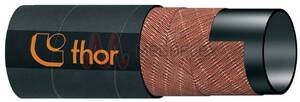
Heavy Duty Shotblast Hose




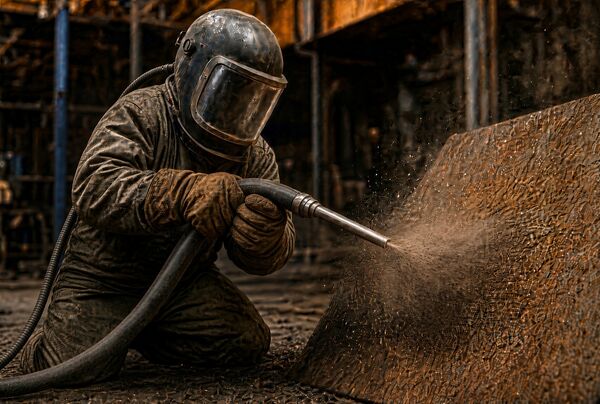
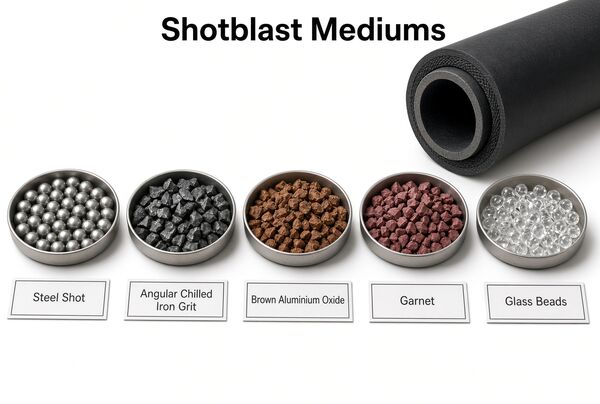
Abrasive blasting is among the most punishing industrial operations a flexible hose assembly can endure. Propelling millions of high-velocity abrasive particles—including steel shot, chilled iron grit, aluminium oxide, garnet, and crushed glass—at operating pressures exceeding 7 to 12 bar (100 to 175 psi) subjects internal hose walls to extreme friction, mechanical wear, and triboelectric static electricity.
Selecting the wrong hose or an uncertified coupling risks rapid wall perforation, electrostatic shocks to blast operators, dangerous coupling blowouts, and unplanned plant downtime. This comprehensive guide explains how to select, size, ground, and connect shotblasting hoses, spent media recovery lines, and external safety couplings.
Need advice or bulk sizing assistance? Contact our technical team at sales@megaflex.co.uk.
How do you specify the correct hose for blast pots, mobile whip lines, media recovery, or dust extraction?
Well, let’s dive in!
How to Select the Perfect Shotblasting Hose in 6 Steps
- 1. Determine Inside Diameter, Wall Thickness & Velocity. Balance air volume (CFM) and nozzle size by selecting between 2-ply and 4-ply hose walls, and sizing main transfer runs vs. lightweight operator whip lines.
- 2. Match Abrasive Media to Tube Wear Resistance. Choose inner tube formulations with standardised DIN 53516 / ISO 4649 abrasion loss ratings under 50 mm³ to withstand steel grit, garnet, and aluminium oxide.
- 3. Assess Static Dissipation & Electrical Conductivity. Prevent operator electric shocks and pinhole wall punctures by specifying conductive rubber compounds (R < 106 Ω) or integrated antistatic copper grounding wires.
- 4. Configure Spent Media Recovery & Dust Extraction. Pair abrasive suction units with polyurethane-lined, wire-reinforced suction hoses and antistatic dust collection ductings.
- 5. Verify Working Pressures & Pneumatic Deadman Controls. Maintain minimum 3:1 to 4:1 safety margins under 10–12 bar blast pot pressures, and configure pneumatic deadman safety lines.
- 6. Specify External Couplings, Nozzle Holders & Safety Clips. Use externally fitted malleable iron couplings, alloy nozzle holders, and safety retaining pins—eliminating internal restrictions and preventing catastrophic decoupling.
- Ready to pick your shotblast hose. Review our categorised product recommendations and technical specification tables.
Why Invest in Dedicated Shotblast Hoses & External Couplings?
In shotblasting facilities, shipyards, mobile blast trailers, and blast rooms, the hose line is an active wear component operating under high mechanical and pneumatic stress. Inferior rubber hoses or general-purpose compressed air lines wear through rapidly when exposed to high-velocity abrasives. In addition, internal wear can cause sudden wall blowouts, while static buildup from dry particle friction can generate dangerous electrical shocks. Specifying purpose-built, high-abrasion shotblast hoses and external safety fittings protects your operators, ensures steady nozzle pressure, and extends service life.
The Real-World Operational Demands of Abrasive Blasting:
- Aggressive Internal Abrasion: Sharp angular abrasives like aluminium oxide, silicon carbide, and crushed iron grit act as cutting tools against polymer surfaces. Premium blast tubes feature high-grade natural and synthetic rubber compounds with DIN 53516 volume loss ratings often under 35–50 mm³.
- Massive Electrostatic Charge (Triboelectric Charging): High-speed friction between non-conductive abrasives and the inner tube generates thousands of volts of static electricity. If not grounded, this charge will arc through the hose wall to earth, puncturing the carcass and delivering severe shocks to the blast gun operator.
- Dynamic External Abuse: Blast hoses are routinely dragged over rough structural steel, concrete curbs, metal grating, and scaffolding. A thick, pin-pricked, weather- and ozone-resistant outer cover prevents ply separation, carcass blistering, and external wear.
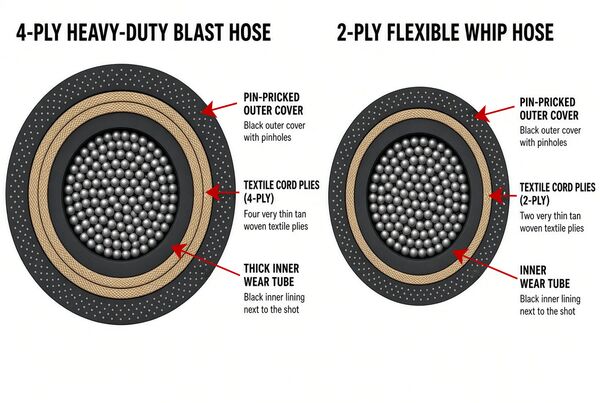
- Operator Ergonomics & Fatigue: Heavy 4-ply blast lines can cause operator fatigue during continuous manual spraying. Adding a flexible 2-ply "whip hose" at the blast nozzle improves operator control and reduces physical strain.
The Value of Premium Blast Hose Assemblies:
- Prevent Blowouts and Project Delays: High-tensile textile cord reinforcement delivers burst pressures of 30 to 48 bar (a 3:1 to 4:1 safety factor on a 10–12 bar working pressure), preventing sudden ruptures.
- Maintain Blast Nozzle Velocity: Calibrated internal diameters minimise turbulence and pressure drop, keeping air pressure steady at the blast nozzle for faster surface cleaning.
- Eliminate Internal Turbulence: External shotblast couplings clamp strictly over the hose's outer diameter, leaving the internal bore free of restrictions that cause premature local wear.
Ready to configure your blasting system? Follow our step-by-step selection guide or contact our technical sales desk at sales@megaflex.co.uk for configuration support.
Step-by-Step Guide to Selecting the Right Shotblast Hose
Step 1: Determine Inside Diameter, Wall Thickness & Velocity
Correct hose sizing balances air volume (CFM), particle velocity, and blast nozzle efficiency:
- Inside Diameter (ID) Sizing Rule: The inside diameter of your main blast hose should be 3 to 4 times the orifice size of the blast nozzle. For example, a No. 5 (5/16" / 8 mm) or No. 6 (3/8" / 9.5 mm) venturi nozzle requires a minimum 1-1/4" (32 mm) ID blast hose. Undersized hoses cause excessive air velocity and severe frictional pressure drop; a loss of just 1 bar (15 psi) at the blast nozzle can reduce blast cleaning production by up to 25%.
- Main Supply Run vs. Whip Hose:
- Main Blast Runs (Heavy-Duty 4-Ply): Standard industrial configurations use 1" (25 mm) or 1-1/4" (32 mm) ID 4-ply hoses—such as the Heavy Duty Shotblast Hose
- Nozzle Whip Lines (Medium-Duty 2-Ply): For the final 3 to 5 metres leading directly to the blast nozzle holder, operators often downsize to a lighter, more flexible 2-ply hose—such as the Conductive Rubber Medium Duty Shotblast Hose
- Main Blast Runs (Heavy-Duty 4-Ply): Standard industrial configurations use 1" (25 mm) or 1-1/4" (32 mm) ID 4-ply hoses—such as the Heavy Duty Shotblast Hose
- Wall Thickness & Fitting Compatibility: Shotblast couplings and nozzle holders slip *over* the outside diameter of the hose. You must match the hose’s OD (e.g., 25x39 mm, 32x48 mm, or 32x55 mm) to the corresponding coupling socket to ensure proper gasket compression and secure screw engagement.
Step 2: Match Abrasive Media to Tube Wear Resistance
The type of abrasive media used determines the rate of abrasive wear on the tube wall:
Impact of Media Density and Geometry
Abrasive blasting media ranges from round, low-wear materials to sharp, highly aggressive grits. Round glass beads and walnut shells cause relatively mild abrasive wear, whereas chilled iron grit, aluminium oxide, and angular garnet cut aggressively into polymer walls. The sharper and denser the particles, the thicker and more resilient the inner tube must be.
Understanding DIN 53516 / ISO 4649 Abrasion Ratings
Abrasion resistance in rubber hoses is tested under DIN 53516 / ISO 4649 by measuring volume loss (in cubic millimetres, mm³) when a sample is subjected to a rotating abrasive wheel under load:
- Standard Commercial Rubber: Often exhibits volume losses of 120 mm³ to 180 mm³, wearing through quickly in abrasive service.
- High-Performance Blast Tubes: High-grade blast hoses—such as the Heavy Duty Shotblast Hose
Step 3: Assess Static Dissipation & Electrical Conductivity
Static control is a vital safety requirement in abrasive blasting:
As dry abrasive media travels through a non-conductive hose at high speeds (often exceeding 100 metres per second), friction generates substantial triboelectric static charges. If not safely dissipated to earth via the blast pot, this static can build to tens of thousands of volts. Uncontrolled static discharges can cause severe shocks that lead to operator injury, ignite flammable solvent vapours in paint and blast yards, or arc through the hose wall, burning pinholes through the rubber and destroying the hose.
Two Methods of Static Dissipation in Shotblast Hoses:
- Conductive Rubber Compounds: Hoses such as the Conductive Rubber Shotblast Hose
- Integrated Metallic Antistatic Grounding Wires: Hoses such as the Antistatic Shotblast Hose
Step 4: Configure Spent Media Recovery & Dust Extraction
Modern blast yards and containment blast rooms require both pressure-delivery lines and high-capacity suction systems for media recovery and dust control:
Spent Abrasive Recovery (Vacuum Suction & Delivery)
After blasting, spent steel shot, garnet, and sand must be vacuumed from ship hulls, storage tanks, and blast room recovery hoppers back to recycling grit classifiers. Because recovering media involves dense, high-volume slug flow, standard delivery hoses cannot be used. Suction hoses require heavy-duty polyurethane liners and crush-resistant helices:
- Urano Heavy Duty Polyurethane Suction Delivery Hose
- Urano PU Antistatic Heavy Duty Polyurethane Hose
- Heavy Duty PU Lined Suction Delivery Hose
Dust Extraction & Filter Unit Ducting
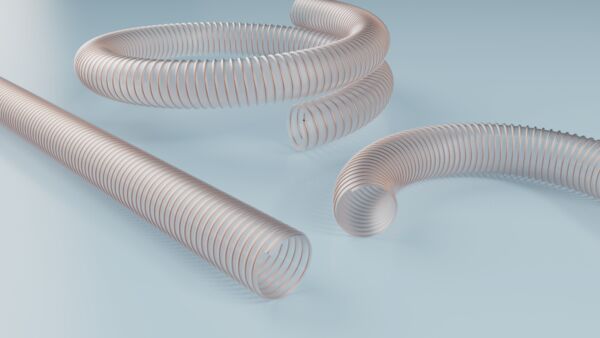
Blast rooms generate high volumes of fine, airborne silica-free dust, rust scale, and fractured media particles that must be evacuated to dust collectors. Flexible antistatic polyurethane ducting is required:
- PROTAPE® PUR 330 AS Ducting
- AIRDUC® PUR 355 AS Standard Ducting
Step 5: Verify Working Pressures & Pneumatic Deadman Controls
High blasting efficiency relies on maintaining proper working pressures and responsive safety controls:
- Operating Pressures & Safety Margins: Industrial blasting typically runs between 7 and 10 bar (100–150 psi), with high-performance vapor-blasting and automated units reaching 12 bar (175 psi). Industrial shotblast hoses—including the Heavy Duty Shotblast Hose
- Pneumatic Deadman Safety Lines (Twinline Control): For remote control of the abrasive metering valve and blast pot pressurisation, operators use a deadman trigger mounted at the blast nozzle. Running pneumatic air signals back to the pot requires dual-line tubing:
- The Green Yellow Gas Hose
- The Green Yellow Gas Hose
Step 6: Specify External Couplings, Nozzle Holders & Safety Clamping
The safety of a high-pressure shotblast line depends heavily on its external connection fittings:
The Rule of External Couplings: Never Use Internal Hose Tails
In standard fluid transfer, fittings are inserted *inside* the hose bore. In shotblasting, inserting an internal fitting tail is dangerous. An internal barb creates an internal step restriction; the abrasive blast stream will hit this step at high velocity, creating severe turbulence that will cut through the hose wall behind the fitting in minutes. Consequently, all shotblast couplings and nozzle holders fit externally over the outside diameter of the hose, leaving the internal bore smooth and unobstructed.
Essential Shotblast Fittings & Safety Components:
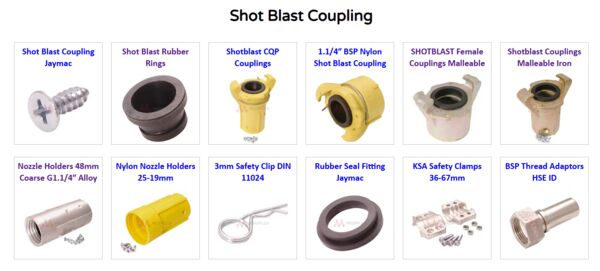
- Shotblast Couplings (Malleable Iron): Heavy-duty claw couplings fitted over the outside of the hose. Secured using countersunk screws that thread through pre-drilled holes in the coupling body into the outer hose carcass without puncturing the inner tube.
- Shotblast Female Couplings (Malleable Iron): Threaded directly onto blast pot outlet valves, providing a secure, quick-connect interface for the main blast hose run.
- Shotblast Rubber Rings / Gaskets: Thick, heavy-profile rubber face gaskets designed to seal when coupling lugs twist together. Worn, flattened, or missing gaskets allow abrasive media to escape, which will cut through coupling lugs. Inspect and replace gaskets regularly.
- Alloy Nozzle Holders (48mm Coarse Thread / 1-1/4" NPSM): Fitted over the operator end of the blast hose to accept standard venturi blast nozzles. Features coarse non-jamming threads that resist seising from fine dust.
- 3mm Safety Clips (DIN 11024): Spring steel safety retaining pins inserted through the locking holes of mated claw couplings. These prevent accidental twisting and decoupling if the hose catches on scaffolding or obstacles.
- KSA Safety Clamps (36–67mm): Precision-formed safety clamps fitted externally around coupling collars to reinforce the connection against high dynamic whipping and axial pull.
- Hose Whip Checks (Safety Cables): Steel safety cables looped across every coupling connection and from the hose to the blast pot. If a coupling fails or uncouples under pressure, the whip check restrains the hose, preventing dangerous whipping injuries.
Why Choosing the Right Shotblast Hose Matters
Using improper, generic, or poorly assembled hoses in abrasive blasting operations can cause severe safety hazards:
- Sudden Pinhole Perforations: Non-conductive hoses allow static charges to arc through the rubber, burning pinhole leaks that escape as high-pressure abrasive jets.
- Coupling Separation: Using incorrect screws, damaged gaskets, or omitting DIN 11024 safety clips can cause couplings to detach under pressure, resulting in an uncontrolled, whipping hose.
- Rapid Wall Wear: Low-abrasion rubber compounds wear through quickly when exposed to aggressive garnet or aluminium oxide, causing premature blowouts.
- Loss of Blast Production: Undersized hoses restrict air volume, dropping nozzle pressures and significantly slowing surface preparation rates.
Ready to Choose Your Shotblast Hose?
Follow this checklist when ordering your abrasive blasting lines:
- Match Hose ID to Nozzle Size: Ensure the internal diameter is 3 to 4 times the blast nozzle orifice to maintain operating velocity.
- Select Carcass Construction: Use heavy-duty 4-ply hoses for long floor runs and flexible 2-ply whip hoses near the nozzle.
- Confirm Static Grounding: Specify conductive rubber (R< 106 Ω) or integrated antistatic copper wires based on site safety rules.
- Size Matching External Couplings: Match the hose’s OD to corresponding malleable iron couplings and alloy nozzle holders.
- Equip Safety Restraints: Always pair couplings with rubber gaskets, DIN 11024 safety pins, and whip check cables.
Top Picks for Shotblasting & Recovery Applications
To assist in specifying equipment for your blasting operations, our hoses are categorised below by process duty:
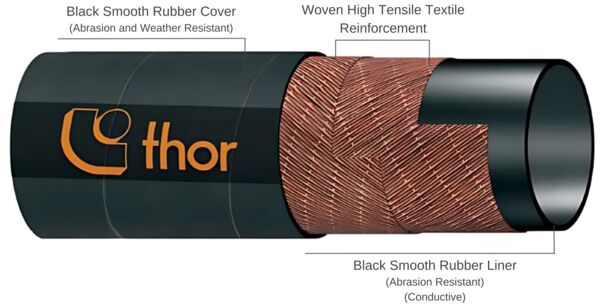
The Heavy Duty Shotblast Hose
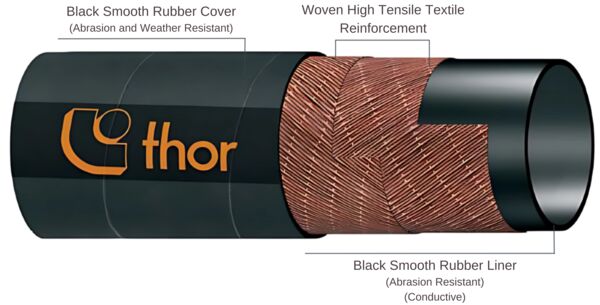
Where static dissipation is critical, the Conductive Rubber Shotblast Hose
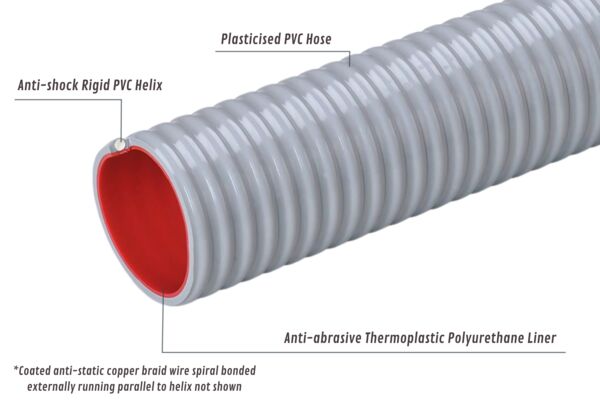
Vacuum recovery of spent steel grit and garnet requires high abrasion resistance under vacuum. The Urano PU Antistatic Heavy Duty Polyurethane Suction Delivery Hose
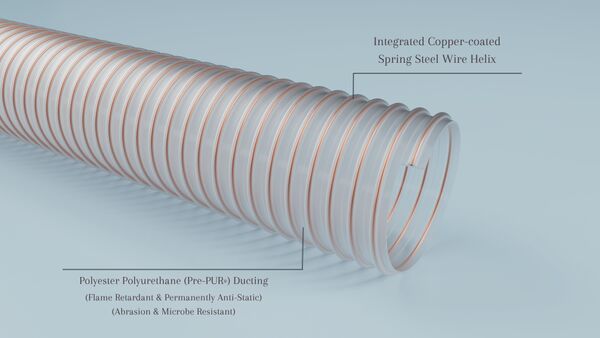
Evacuating dust, rust scale, and broken media particles from blast rooms requires antistatic ducting. The AIRDUC® PUR 355 AS Standard Ducting
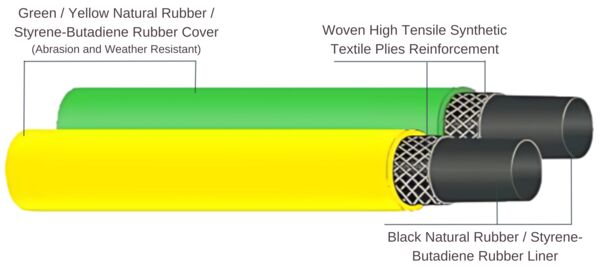
Complete your blast assembly using Shotblast Malleable Iron Couplings and Female Couplings fitted with durable Shotblast Rubber Rings. Secure coupling lugs with DIN 11024 Safety Clips and clamp with KSA Safety Clamps. Mount blast nozzles via Alloy Nozzle Holders, and power pneumatic deadman switches using flexible Green Yellow Gas Hose
Shotblast & Recovery Technical Specifications
The table below provides technical data for our primary shotblasting, recovery, and suction hoses:
| Part Code | Internal Diameter (mm / Inch) | Reinforcement Structure | Tube Abrasion Rating | Working Pressure | Vacuum Rating | Primary Blast Process Application |
|---|---|---|---|---|---|---|
| T871 (Heavy Duty) | 13 mm – 76 mm (1/2" – 3") | High-tensile textile (4-ply) | < 50 mm³ (DIN 53516) | 12 Bar (175 psi) | Delivery Only | Heavy-duty blast pot lines, steel grit, aggressive abrasives |
| T874A (Conductive) | 19 mm – 38 mm (3/4" – 1.5") | High-tensile textile (4-ply) | < 50 mm³ (DIN 53516) | 10 Bar (145 psi) | Delivery Only | Main blast runs requiring continuous static dissipation (R< 106 Ω) |
| T874B (Medium Duty) | 13 mm – 32 mm (1/2" – 1.25") | High-tensile textile (2-ply) | < 60 mm³ (DIN 53516) | 10 Bar (145 psi) | Delivery Only | Flexible operator nozzle whip lines, compact blast cabinets |
| T874 (Standard) | 13 mm – 51 mm (1/2" – 2") | High-tensile textile cords | < 60 mm³ (DIN 53516) | 10 Bar (145 psi) | Delivery Only | General abrasive blasting with garnet, slag, and silica sand |
| SHOT (Antistatic) | 19 mm – 32 mm (3/4" – 1.25") | Textile plies + copper wire | < 50 mm³ (DIN 53516) | 10 Bar (145 psi) | Delivery Only | Blast lines requiring mechanical grounding to metal couplings |
| UR02 (Urano PU Antistatic) | 25 mm – 152 mm (1" – 6") | Rigid PVC helix + copper wire | Polyurethane (High Wear) | 1.5 – 6 Bar (size dependent) | Full Vacuum (0.9 Bar) | Spent abrasive recovery, vacuum grit hoppers, tank cleanout |
| UH01 (Heavy Duty PU Lined) | 38 mm – 152 mm (1.5" – 6") | Embedded PVC helix + PU liner | Polyurethane (< 30 mm³) | 2 – 5 Bar (size dependent) | Full Vacuum (0.9 Bar) | Heavy abrasive slurry, shot recovery, mobile suction trucks |
| 355-0000 (AIRDUC® 355 AS) | 40 mm – 300 mm (1.5" – 12") | Spring steel wire helix | Polyurethane (< 25 mm³) | Ducting Range | Medium/High Vacuum | Blast room central dust collector lines, ventilation exhaust |
Which Hose Setup Is Right for Your Blasting System? For main supply lines from the blast pot, the T871 Heavy Duty Shotblast Hose provides optimal wall thickness and abrasion resistance. Where static shocks pose a risk, use the T874A Conductive Rubber Shotblast Hose. For flexible nozzle handling, add a short section of T874B Medium Duty as an operator whip hose. For vacuuming spent media back to separators, choose the wire-grounded UR02 Urano PU Antistatic Hose. Need assistance matching external couplings or sizing nozzle holders? Email sales@megaflex.co.uk.
Final Thoughts
Maintaining safety, productivity, and profitability in abrasive blasting operations requires properly matched hose and coupling systems. Purpose-built shotblast hoses—featuring high-abrasion inner tubes, static-dissipating compounds, and robust 4-ply cord reinforcement—withstand continuous punishment from aggressive abrasives. Paired with external malleable iron couplings, alloy nozzle holders, and safety retaining pins, they eliminate internal flow restrictions, prevent operator injury, and minimise costly downtime. Looking for bespoke assemblies or coupling recommendations? Contact our technical team today at sales@megaflex.co.uk!
Check Out Our Other Blogs
Explore our other technical articles and practical hose guides:
- Scaling Modern Aquaculture: The Critical Role of Heavy-Duty Fish Transfer Hoses
- Conduits at Megaflex: Material Matters
- PolyAlu Tubing: Revolutionising Durability in Harsh Environments
- How to Calculate Bend Radius: A Comprehensive Guide
Visit our blog homepage for more industrial fluid handling insights!
Shotblasting Hoses & Couplings FAQ
Have questions about selecting, maintaining, or grounding your abrasive blasting hoses? Click any question below to reveal the technical answer. For bespoke assemblies, safety fittings, or quote enquiries, contact us at sales@megaflex.co.uk!
Click a question to read the answer:
Standard industrial compressed air hoses are not designed to withstand abrasive friction. Blasting media travelling at high velocity will quickly erode generic rubber or PVC inner tubes, leading to wall failure within hours. In addition, standard air hoses lack static-dissipating compounds, risking severe electrostatic shocks to the operator and pinhole wall punctures.
Inserting an internal hose tail or barb creates an internal step inside the bore. High-velocity abrasive particles strike this step, creating severe local turbulence that erodes the rubber wall behind the fitting in minutes. External couplings slip over the hose’s outer diameter and are secured from the outside with screws, keeping the internal bore smooth and unobstructed.
A whip hose is a shorter, lighter, and more flexible 2-ply blast hose (such as the T874B) typically 3 to 5 metres in length, installed between the rigid 4-ply main supply line and the blast nozzle. It reduces wrist strain and operator fatigue, allowing better nozzle control when working in tight corners or at awkward angles.
Static electricity builds via triboelectric charging as dry, non-conductive abrasive particles rub against the hose wall at high speeds. It is safely dissipated by using conductive rubber hoses (with electrical resistance R< 106 Ω/m) or hoses with integrated copper grounding wires, which route the electrical charge through metal couplings back to the grounded blast pot.
The internal diameter of the blast hose should be 3 to 4 times the orifice diameter of the blast nozzle. For instance, a No. 5 (5/16" / 8 mm) nozzle should be paired with at least a 1-1/4" (32 mm) ID hose. Using an undersized hose creates excessive friction and pressure drops, significantly reducing cleaning production rates.
The plies refer to the layers of high-tensile textile cord reinforcement embedded in the hose carcass. A 4-ply hose (like the T871) provides higher kink resistance, greater rigidity, and superior crush resistance for long floor runs. A 2-ply hose (like the T874B) has a thinner, more pliable wall that delivers maximum flexibility for nozzle whip lines.
Blasting operates under high pressure (7–12 bar). If mated claw couplings snag or twist on obstacles, they can decouple violently. DIN 11024 spring steel safety pins prevent coupling claws from disengaging, while steel whip check cables physically restrain the hose if a connection separates, preventing injury from whipping hoses.
Gaskets should be inspected at the start of every shift. If a gasket is worn, grooved, hardened, or fails to form an airtight seal when coupled, it must be replaced immediately. Leaking gaskets allow abrasive particles to escape into the coupling joint, which erodes the malleable iron lugs and can cause coupling failure.
Spent media recovery requires heavy-duty polyurethane-lined suction and delivery hoses such as the UR02 Urano PU Antistatic or UH01 Heavy Duty PU Lined hose. These feature thick, wear-resistant polyurethane inner tubes and rigid PVC spirals that handle vacuum draw without collapsing under heavy grit loads.
This rating measures the volume loss of rubber (in cubic millimetres, mm³) when subjected to friction against a standardised rotating abrasive drum. Lower numbers indicate greater abrasion resistance. High-performance blast hoses feature ratings under 50 mm³ (or even < 35 mm³), whereas standard commercial rubber loses 120 mm³ to 200 mm³.
A pneumatic deadman handle mounted at the blast nozzle connects back to the pot's control valve via dual-line hose (such as the Green Yellow Gas Hose TLINE). When the operator presses the lever, air signals open the pot's abrasive and air valves. Releasing the lever immediately vents the control line, depressurising the system and stopping the blast stream in milliseconds.