Brewer’s Food-Grade Hoses & Hygienic Fittings Guide: From Wort to Kegging
Brewery Fluid Handling & Hose Guide
Updated September 15, 2026
Product links mentioned in this blog:Red Brewers Delivery Hose


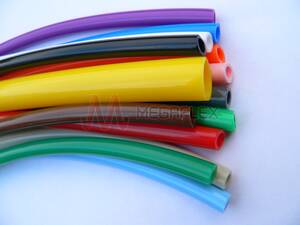
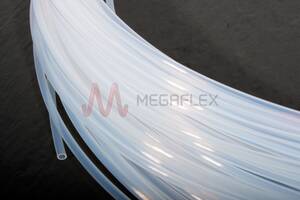

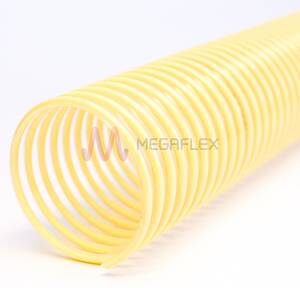
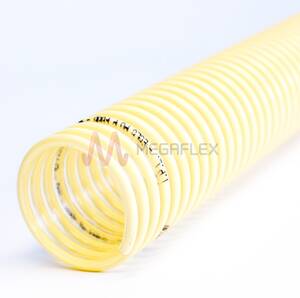
In modern craft brewing, microbrewing, and large-scale industrial beverage production, beer quality, flavour consistency, and operational safety depend directly on fluid transfer equipment. From transporting abrasive grist and boiling sweet wort to managing active fermentation, bright beer transfer, packaging, and caustic Clean-in-Place (CIP) sanitation, each stage presents distinct chemical, thermal, and microbiological challenges. Substandard or mismatched hoses risk leaching plasticisers, imparting rubbery or phenolic off-flavours, harbouring wild yeast and bacterial biofilms, or collapsing under vacuum. This comprehensive guide examines how to select, size, configure, and maintain food-grade brewery hoses and sanitary connection systems to ensure compliance with FDA 21 CFR and European Regulation (EC) No 1935/2004 standards.
How do you specify the right hose for boiling wort, bright beer, hot caustic CIP, or cellar washdown?
Well, let’s dive in!
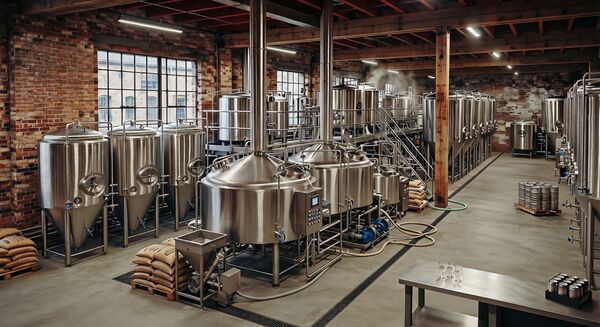
How to Select the Perfect Brewery Hose in 6 Steps
- 1. Determine Hose Sizing, Flow Dynamics & Vacuum Demands. Match inside diameter (ID) to pump volumetric flow rates to avoid shear stress, and choose between delivery-only lines or wire-helix reinforced suction and delivery hoses to prevent vacuum collapse during tank knockouts.
- 2. Identify the Process Medium & Chemical Exposure. Specify appropriate inner liner materials for boiling sweet wort, finished beer, dry grains, volatile spirits, high-temperature caustic flushes, or peracetic acid sanitisation.
- 3. Assess Thermal Cycling, Working Pressures & Sterilisation Limits. Account for operating temperatures ranging from near-freezing cellar conditioning to boiling wort (+100°C) and steam sterilisation (+110°C to +130°C), while applying temperature de-rating factors to working pressures.
- 4. Factor in Cellar Wear, Floor Abrasion & Environmental Durability. Select outer covers resistant to ozone, UV light, mechanical dragging, hot liquor puddles, yeast slurry, and aggressive sanitiser pooling.
- 5. Verify Hygiene Standards, Purity & Taste Neutrality. Confirm material compliance with FDA 21 CFR 177.2600, Regulation (EC) No 1935/2004, and EU 10/2011 to eliminate plasticiser migration, off-odours, and flavour scalping.
- 6. Specify Sanitary 316L Hygienic Connections & Proper Assembly. Pair hoses with crevice-free Tri-Clamp, RJT, or DIN 11851 fittings secured with 360° swaged stainless steel ferrules to eliminate internal microbial bug traps.
Why Invest in Dedicated Food-Grade Brewery Hoses?
Beer is an organic, biologically sensitive beverage that readily absorbs volatile compounds and oxidises upon contact with inferior materials. Transfer lines built from standard non-food rubber or low-grade plastics can leach chemical plasticisers, alter crisp hop aromas, or impart rubbery, phenolic off-flavours that ruin entire production volumes. Furthermore, brewing operations subject hoses to aggressive thermal cycling—moving from near-boiling wort to freezing cold cellar conditions, followed by aggressive chemical sanitation flushes. High-grade brewery hoses protect your beer, guarantee biological stability, and prevent costly production losses.
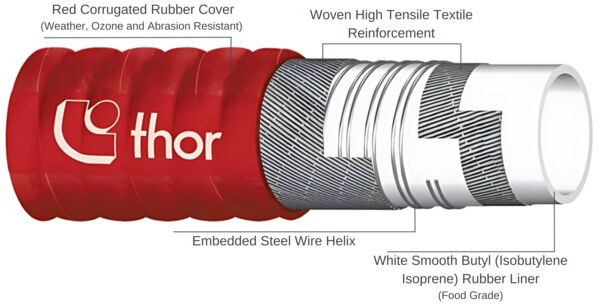
Whether running a 5-barrel microbrewery or a 100-barrel automated production facility, fluid lines must meet high mechanical, chemical, and hygienic standards.
The Operational Demands of Modern Brewing Systems:
- Flavour and Aroma Protection: Finished beer absorbs volatile hydrocarbons. High-purity food-grade liners (such as white virgin EPDM, ultra-pure IIR butyl, pharmaceutical-grade TPE, and UHMWPE) are completely inert, taste-free, odourless, and free of phthalates and bisphenol-A (BPA).
- Microbiological Safety: Pitted, rough, or porous inner linings provide micro-crevices where spoilage bacteria (such as Lactobacillus and Pediococcus) and wild yeasts (such as Brettanomyces) can lodge and develop biofilms. Mirror-smooth inner bores ensure complete chemical cleaning and hot-water sanitisation.
- Vacuum and Pressure Resilience: Chilling boiling wort through plate heat exchangers creates significant vacuum draw. Without a high-tensile steel wire helix, standard hoses collapse internally, causing pump cavitation and process stoppage.
- Resistance to Aggressive Cleaning Regimes: Regular brewhouse sanitation involves caustic soda (sodium hydroxide, 2–4% at 70°C–85°C), nitric/phosphoric acid descalers (to remove calcium oxalate or "beerstone"), and oxidative sanitisers (peracetic acid / PAA). Standard general-purpose hoses swell, crack, and delaminate under these chemicals.
The Return on Quality Fluid Transfer Assemblies:
- Prevent Product Loss: Eliminate chemical contamination, oxidation pick-up, and microbial infection risks across all fermentation and conditioning stages.
- Protect Cellar Operators: Washdown hoses and hot wort transfer lines designed with multi-ply textile cord reinforcement and high burst safety margins (typically 3:1 or 4:1) protect workers from scalding burns and line blowouts.
- Extended Service Life: Heavy-duty synthetic covers resist floor dragging, heavy foot traffic, ozone exposure, and hot water pooling, reducing maintenance downtime and replacement cycles.
Ready to upgrade your cellar transfers? Jump to our step-by-step selection guide or contact our technical team at sales@megaflex.co.uk for advice.
Step-by-Step Guide to Selecting the Right Brewery Hose
Step 1: Determine Hose Sizing, Flow Dynamics & Vacuum Demands
Accurate sizing prevents product shear, oxygen pickup, high line friction, and cavitation:
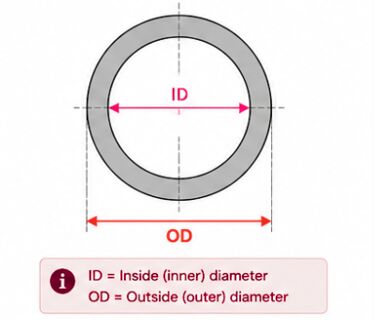
- Inside Diameter (ID): Sizing must balance fluid velocity and volumetric flow rate. Standard brewhouse sizes include 25 mm (1"), 32 mm (1.25"), 38 mm (1.5"), 51 mm (2"), and 63.5 mm (2.5"). Undersized hoses increase line friction, produce backpressure, and introduce shear forces that can damage yeast cells during pitching or break carbonation out of solution during packaging. Oversized hoses add unnecessary tare weight and retain excessive residual beer during line purging.
- Suction vs. Delivery Requirements:
- Delivery Only: Flexible, lightweight textile-reinforced hoses—such as the Red Brewers Delivery Hose or Pharmapress Clear TPE Rubber Delivery Hose—are suited for positive-pressure discharge runs, such as transfers between bright beer tanks (BBTs), centrifuge outlets, filtration skids, and automated keg-filling or canning manifolds.
- Suction and Delivery (Vacuum Resistance): Pumping out of low cellar tanks, extracting boiling wort from the kettle, or drawing through plate chillers generates negative pressure. Hoses reinforced with an embedded high-tensile spring steel wire helix—such as the Beerstar SPC/E0C and Cobeer SPC/E0C—withstand full vacuum (up to 0.9 bar / 9 mH₂O) without tube collapse or ovalisation.
- Dynamic Bend Radius: Crowded brewhouse floors and vessel manifold skids require tight routing. Check minimum bend radius ratings to prevent tube kinking, which restricts flow and places mechanical stress on the end ferrules.
Tip: For portable pump carts, specify high-flexibility suction and delivery hoses to allow easy manoeuvring between unitanks without straining vessel butterfly valves.
Step 2: Identify the Process Medium & Chemical Exposure
Every phase of brewing involves different media chemistries that dictate hose liner material selection:
Hot Sweet Wort & Hoppy Liquors (Boil to Chiller)
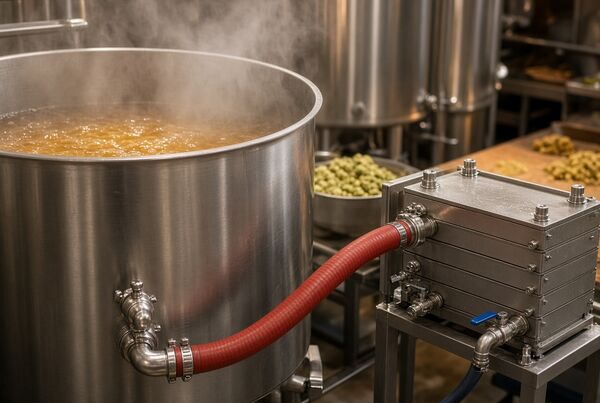
Boiling wort contains dissolved sugars, suspended hop resins, and trub proteins at temperatures between 90°C and 100°C. Inner liners must resist thermal degradation while remaining non-porous. White food-grade EPDM or synthetic elastomers (featured in the Red Brewers Delivery Hose and Beerstar SPC/E0C) handle boiling temperatures and aggressive hop alpha-acids without leeching rubber compounds.
Fermenting Beer, Conditioning Media & Craft Spirits
Finished beers, sour ales, ciders, and high-proof craft distillates require non-absorbent, taste-neutral contact surfaces. High-alcohol products (>20% ABV) can extract plasticisers from conventional plastic hoses. High-proof alcohol transfer requires ultra-pure synthetic rubber compounds, such as the Beerstar SPC/E0C, the Pharmapress Clear TPE Hose, or the Chemical Food Suction Delivery Hose, which handle up to 96% proof alcohol.
Clean-in-Place (CIP) Caustics & Sanitising Acids
Cleaning protocols alternate between hot sodium hydroxide (caustic soda, 2–4% at 75°C–85°C) to dissolve organic proteins, nitric/phosphoric acid blends to dissolve mineral beerstone, and peracetic acid (PAA) to sanitise. Concentrated chemical handling calls for the UHMWPE Multipurpose Green Chemical Delivery Hose or Flexible PTFE Tubing, which offer broad chemical resistance across the entire pH 0–14 range.
Gas Sparging, Carbonation & Pneumatic Automation (CO₂ & N₂)
Carbonating bright tanks, counter-pressure filling lines, purging vessels, and actuating pneumatic valves require gas-impermeable tubing. Metric Flexible Nylon Tube and Flexible PTFE Tube prevent atmospheric oxygen ingress and stop high-pressure carbon dioxide from permeating through tube walls.
Dry Grain, Whole Grist, Hops & Spent Grain Handling
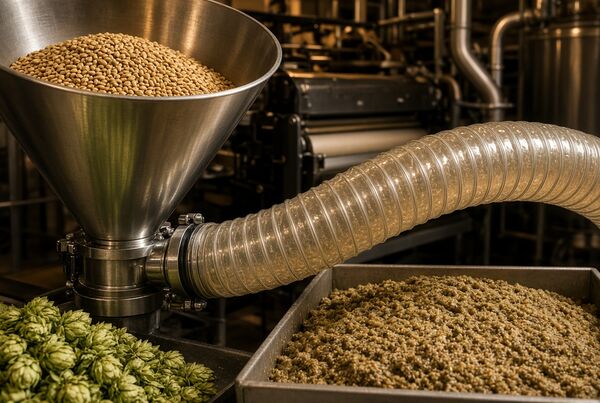
Pneumatic transfer of whole malt from silos, grist auger conveyance, and spent grain slurry disposal generate significant abrasive wear. Flexible polyurethane ductings like Master-PUR H Food A Grade, Food Quality Polyurethane Ducting, and Food Grade Polyurethane Ducting feature ether-based polyurethane walls that provide up to five times the abrasion resistance of standard PVC, while resisting moisture and microbial growth.
Step 3: Assess Thermal Cycling, Working Pressures & Sterilisation Limits
Brewery hoses undergo frequent, severe thermal shifts that can accelerate fatigue in low-grade materials:
- Boiling Wort Knockout Temperatures (+90°C to +100°C): Wort kettle-to-chiller transfer lines must maintain structural stability under high heat. While typical industrial hoses soften and lose pressure capacity at 60°C, the Red Brewers Delivery Hose and Beerstar SPC/E0C operate continuously at +100°C.
- Steam Sterilisation (SIP) and Hot Water Sanitisation (+110°C to +130°C): Thorough sanitation often requires low-pressure saturated steam flushes (+110°C for up to 30 minutes with the Beerstar SPC/E0C; +130°C intermittently with the Red Brewers Delivery Hose). Thermoplastic or PVC hoses must never be steam cleaned, as they will soften, blister, and suffer wall collapse.
- Pressure De-Rating Under Heat: A hose rated for 10 bar (145 psi) working pressure at ambient temperature (20°C) experiences reduced structural pressure capacity as temperatures rise. For operations involving hot water or boiling wort, consult pressure de-rating curves to maintain an appropriate safety factor.
- Cellar Washdown Pressures and Thermal Duty: Brewhouse floor sanitation requires dedicated washdown lines. The Blue EPDM Dairy Washdown Hose, the Food Quality Washdown Hose, and the Clean Washdown Hose handle washdown pressures up to 10–20 bar and temperatures up to +95°C–100°C, providing safe hot water handling for cleaning guns.
Step 4: Factor in Cellar Wear, Floor Abrasion & Environmental Durability
Brewhouse cellars present challenging external environments for transfer lines:
Flooring Abrasion & Chemical Puddles
Hoses are dragged across wet, abrasive non-slip epoxy, resin screed, or quarry tile flooring. Cellar floors frequently have standing pools of residual caustic cleaner, peracetic acid, sour beer trub, and yeast slurry. Premium brewery hoses feature oil-, weather-, and ozone-resistant synthetic covers that resist swelling, surface cracking, and rotting.
Visual Process Monitoring (Clear Tubing Options)
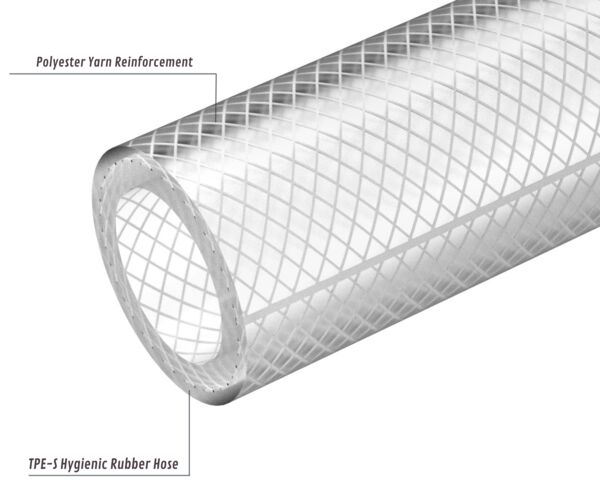
During transfer, racking, or filtration, operators often need visual verification of liquid clarity, yeast sediment separation, and bubble-free transfer. Transparent food-grade hoses—such as Plutone Clear PVC, Plutone Press Clear PVC, Arianna Clear PVC, and Food Quality Clear PVC Suction Discharge Hose—allow direct optical inspection of beer colour and clarity during cold-side processing. For higher purity, the Pharmapress Clear TPE Rubber Delivery Hose provides a transparent, ultra-clean, rubber-flexible alternative.
Non-Marking Outer Covers
Maintaining a clean brewhouse aesthetic requires non-marking hoses. Hoses such as the Blue EPDM Washdown Hose use smooth, non-marking outer covers that prevent coloured scuff marks across painted cellar floors.
Step 5: Verify Hygiene Standards, Purity & Taste Neutrality
Direct-contact beverage transfer equipment must adhere to international food contact directives:
- FDA 21 CFR 177.2600 & 177.1550: Governs rubber compounds and fluoropolymers in direct, repeated contact with aqueous, fatty, and alcohol-containing food products.
- European Regulation (EC) No 1935/2004 & EU 10/2011: Mandates that materials transfer no constituents into beer in quantities that endanger health or cause an unacceptable change in composition, taste, colour, or aroma.
- Phthalate-Free, Plasticiser-Free & BPA-Free: Traditional industrial plastics use phthalate plasticisers that leach into high-alcohol products or hot liquids. Specifying food-grade formulations like Pharmapress TPE, virgin EPDM, or PTFE prevents chemical migration.
- Liner Smoothness & Anti-Adhesion: High-purity mirror-smooth internal surfaces prevent the accumulation of "beerstone" (calcium oxalate crystals) and organic trub, allowing fast CIP sanitation cycles and reducing water consumption.
Step 6: Specify Sanitary 316L Hygienic Connections & Proper Assembly
Even the highest-specification hose can become a point of contamination if paired with non-hygienic fittings or improper clamping systems. Industrial worm-drive clips and serrated brass stems create crevices that compromise hygiene:
The Hazard of Worm-Drive Clamps ("Bug Traps")
Using worm-drive (Jubilee-style) band clips on brewery product transfer lines creates an internal gap between the hose liner and the fitting barb. Trub, wort, and beer collect in this recess. These trapped deposits are shielded from high-velocity CIP fluids, creating persistent bacterial contamination points that can spoil subsequent batches. High-hygiene operations require factory-crimped, swaged stainless steel ferrules.
Core Hygienic Brewery Fitting Profiles:
- Tri-Clamp (BS 4825-3 / ASME BPE): The standard fitting system for craft and commercial breweries worldwide. Tri-Clamp fittings use two flanged ferrules, a precision-moulded elastomeric gasket, and a hinged mechanical clamp. The connection provides a flat, crevice-free internal joint that can be disassembled tool-free for inspection.
- RJT Fittings (BS 4825-5): British standard hygienic fittings comprising an externally threaded male part, a stepped liner, a hexagonal nut, and an O-ring joint. RJT connections handle robust cellar handling and higher working pressures.
- DIN 11851 Sanitary Couplings: European standard hygienic fittings featuring a coarse round thread, slotted spanner nut, and D-ring flush seal. Widely specified on German and continental brewing equipment.
- SMS 1145 Sanitary Connections: Swedish hygienic standard featuring a compact, low-profile threaded design with a flat sealing ring, common in automated beverage processing skids.
- Factory-Crimped 316L Stainless Steel Ferrules: Product transfer hoses must be assembled using precision-swaged 316L stainless steel hygienic hose tails and interlocking outer ferrules. This mechanical crimp creates a smooth, permanent internal transition that prevents leaks, resists thermal shock, and eliminates bacterial pockets.
- Sanitary Gasket Materials: Match your connection seals to process conditions:
- Food-Grade EPDM: Well-suited for hot wort, boiling liquor, and low-pressure steam; resistant to hot caustics.
- FKM (Viton): Recommended for high-acid environments and concentrated chemical sanitising lines.
- PTFE / Encapsulated Silicone: Zero-creep, non-absorbent seals offering high chemical and thermal stability across all brewing media.
Why Choosing the Right Brewery Hose Matters
Using generic or mismatched hoses in brewing operations can lead to significant problems:
- Off-Flavour Leaching: Vulcanisation chemicals from low-grade rubber leach into finished beer, producing medicinal, rubbery, or plastic off-flavours.
- Microbial Infiltration: Pitted inner walls foster persistent Lactobacillus or wild yeast infections that resist chemical flushes, souring beer and triggering product recalls.
- Vacuum Implosion: Unreinforced hoses collapse under suction when pumping hot wort through a plate heat exchanger, stopping flow and risking pump damage.
- High-Temperature Line Ruptures: Non-steam-rated washdown lines can rupture during thermal sanitisation, presenting severe scalding risks to cellar staff.
Ready to Choose Your Brewery Hose?
Follow this checklist when ordering brewery transfer lines:
- Map the Application: Confirm whether the line will carry boiling wort, conditioning beer, high-proof spirits, caustic CIP chemicals, or washdown water.
- Check Pressure and Vacuum Requirements: Note maximum pump delivery pressures and determine if suction resistance (steel helix) is required.
- Specify Internal Diameter: Match hose ID to process piping (typically 1", 1.5", 2", or 2.5") to maintain flow rates and minimise product agitation.
- Select Sanitary End Terminations: Choose 316L stainless steel Tri-Clamp, RJT, or DIN 11851 ends with factory-crimped, hygienic swaged ferrules.
- Verify Food Certifications: Confirm FDA, EC 1935/2004, and phthalate-free documentation for full regulatory traceability.
Top picks for Brewery Applications
To assist in selecting the appropriate hose for your brewhouse, our transfer lines are categorised below by process application:
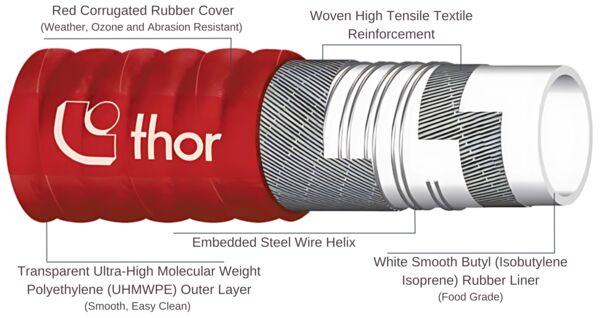
The Beerstar SPC/E0C is engineered for the suction and delivery of beer, wine, sweet wort, cider, and high-proof alcohol up to 96%. Featuring a smooth, white food-grade elastomer tube, high-tensile textile reinforcement, and an embedded steel wire helix, it provides a 10 bar working pressure and full vacuum resistance (0.9 bar). It withstands CIP cycles and steam sanitisation up to +110°C, making it a reliable choice for cellar transfer loops. For positive-pressure delivery between conditioning tanks and packaging lines, the Red Brewers Delivery Hose and Cobeer SPC/E0C provide high durability and kink resistance.
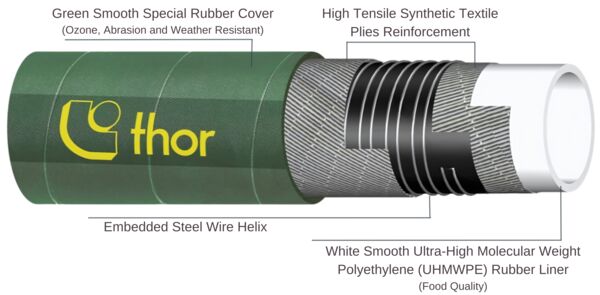
Automated CIP loops use concentrated caustic soda at elevated temperatures and sanitising acids. The UHMWPE Multipurpose Green Chemical Delivery Hose features an ultra-smooth, food-grade UHMWPE inner liner that resists 98% of industrial chemicals, including hot caustic soda flushes and peracetic acid. For combined chemical and food suction duties, consider the Chemical Food Suction Delivery Hose, or use Flexible PTFE Tubing for continuous high-temperature service up to 250°C.
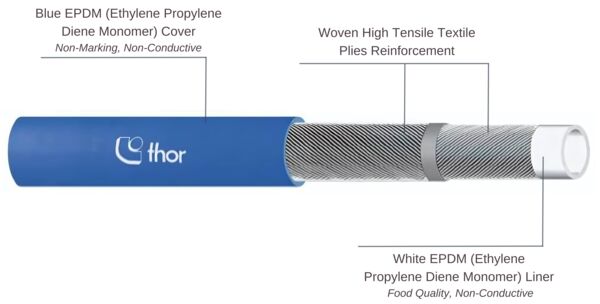
Brewhouse floor maintenance requires heavy-duty hot water delivery hoses. The Blue EPDM Dairy Washdown Hose, the Food Quality Washdown Hose, and the lightweight Clean Washdown Hose handle washdown pressures up to 10–20 bar and temperatures up to +95°C–100°C. Their non-marking covers protect painted cellar floors and resist breakdown from contact with animal fats, lactic acid, and peracetic acid.
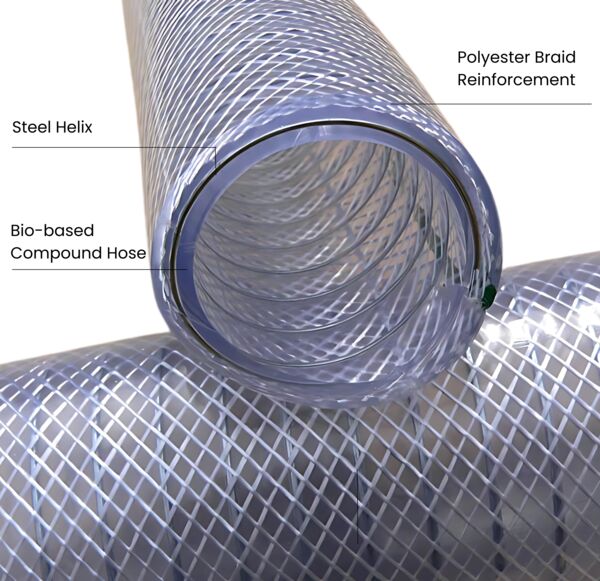
For applications requiring visual flow inspection, such as bright beer racking, trub separation, or filtration loops, the Plutone Clear PVC Suction Delivery Hose, Plutone Press Clear PVC, Arianna Clear PVC, and Food Quality Clear PVC Suction Discharge Hose provide transparent, food-grade pathways. For ultra-pure craft brewing, yeast harvesting, or sensitive sampling, the Pharmapress Clear TPE Delivery Hose provides a clear, highly flexible, rubber-grade alternative.
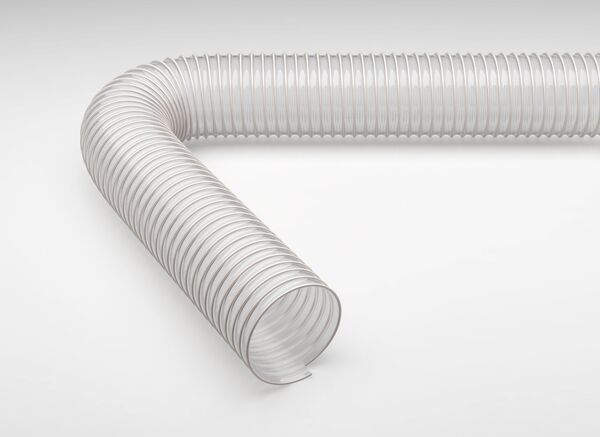
Conveying whole malt, grist, and spent grain mash requires high abrasion resistance. Master-PUR H Food A Grade Polyurethane Ducting, Food Quality Polyurethane Ducting, and Food Grade Polyurethane Ducting feature smooth internal bores and food-certified polyurethane walls that significantly outwear standard PVC, resisting grain friction, moisture, and microbial buildup.
Brewery Hose Technical Specifications
The table below provides technical data for our primary food-grade brewery suction and delivery hoses:
| Hose Model | Internal Diameter (mm / Inch) | Liner Polymer | Temperature Range | Working Pressure at 20°C | Vacuum Resistance | Primary Brewhouse Application |
|---|---|---|---|---|---|---|
| Beerstar SPC/E0C | 25 mm – 102 mm (1" – 4") | White Food Elastomer | -30°C to +100°C (Steam +110°C) | 10 Bar (145 psi) | 0.9 Bar (90%) | Hot wort, beer, wine, high-proof spirits, cider transfer |
| Red Brewers Delivery | 25 mm – 76 mm (1" – 3") | White Smooth EPDM | -40°C to +100°C (Steam +130°C) | 10 Bar (145 psi) | Delivery Only | Hot liquor lines, boiling wort knockout, bright beer discharge |
| Cobeer SPC/E0C | 25 mm – 76 mm (1" – 3") | White Food NBR/Elastomer | -30°C to +100°C (Steam +110°C) | 10 Bar (145 psi) | 0.9 Bar (90%) | Suction & delivery for bright beer, wine, and yeast transfer |
| UHMWPE Chem Green | 19 mm – 102 mm (0.75" – 4") | Mirror-Smooth UHMWPE | -35°C to +100°C | 16 Bar (232 psi) | 0.9 Bar (90%) | Hot caustic CIP, sanitising acid cycles, peracetic acid flush |
| Plutone Clear PVC | 19 mm – 102 mm (0.75" – 4") | Clear Food PVC (Steel Helix) | -10°C to +60°C | 3 – 7 Bar (size dependent) | 0.7 – 0.9 Bar | Visual flow monitoring, cold beer transfer, yeast recovery |
| Pharmapress TPE | 6.3 mm – 25.4 mm (0.25" – 1") | Ultra-Pure Clear TPE | -30°C to +100°C (Steam +121°C) | 5 – 10 Bar (size dependent) | Delivery Only | Pure yeast propagation, sterile sampling, craft distillates |
| Blue EPDM Washdown | 13 mm – 25 mm (0.5" – 1") | Smooth White EPDM | -30°C to +100°C | 10 – 20 Bar (size dependent) | Delivery Only | Brewhouse floor washdown, vessel exterior hot cleaning |
| Master-PUR H Food | 38 mm – 203 mm (1.5" – 8") | Food Ether Polyurethane | -40°C to +90°C | Ducting Pressure Range | Medium Vacuum | Dry malt conveyance, grist handling, spent grain removal |
Which Hose Setup Is Right for Your Brewhouse? For main fluid transfer from kettle to bright beer tanks, the Beerstar SPC/E0C is the primary choice due to its temperature tolerance, taste-free liner, and full vacuum rating. For washdown duties, specify the Blue EPDM Washdown Hose. For high-temperature CIP loops, use the UHMWPE Green Chemical Hose. Need help choosing hygienic fittings or sizing your lines? Email sales@megaflex.co.uk.
Final Thoughts
Maintaining product quality and brand reputation in commercial brewing requires reliable fluid transfer lines. High-grade, food-certified brewery hoses paired with sanitary 316L stainless steel Tri-Clamp, RJT, or DIN 11851 connections prevent off-flavours, reduce infection risks, and ensure operator safety during high-temperature transfers and chemical cleanings. By selecting hoses suited to your operating temperatures, chemical media, and pressure dynamics, you protect both your process and your beer. Looking for a quote? Contact our technical team today at sales@megaflex.co.uk!
Check Out Our Other Blogs
Explore our other technical articles and practical hose guides:
- Eolo PU Ducting: The Ultimate Solution for Food-Grade Material Transfer
- Conduits at Megaflex: Material Matters
- PolyAlu Tubing: Revolutionising Durability in Harsh Environments
- How to Calculate Bend Radius: A Comprehensive Guide
Visit our blog homepage for more practical insights!
Brewery Hose & Hygienic Fittings FAQ
Have questions about selecting, sizing, or maintaining your brewery fluid transfer lines? Click any question below to view the technical answer. For bespoke assemblies and sanitary fittings advice, contact our engineering team at sales@megaflex.co.uk!
Click a question to read the answer:
Standard industrial hoses contain plasticisers and chemical stabilisers that leach into beer, imparting rubbery, plastic, or phenolic off-flavours. In addition, their porous internal surfaces can harbour spoilage bacteria (such as Lactobacillus and Pediococcus) and wild yeasts. Non-food-grade hoses can also soften, lose pressure integrity, and collapse when exposed to boiling wort or chemical cleaners.
Delivery-only hoses are lightweight and flexible, intended strictly for positive-pressure fluid transfer. Suction and delivery hoses (such as the Beerstar SPC/E0C) incorporate an embedded high-tensile steel wire helix. This reinforcement prevents the hose from collapsing under negative pressure when pulling liquid from vessels or operating under centrifugal pump suction.
Worm-drive clips provide uneven clamping pressure and leave exposed hose barbs inside the line, creating internal gaps ("bug traps") where wort, beer, and trub collect. These trapped deposits are shielded from Clean-in-Place (CIP) cleaning cycles, creating persistent bacterial contamination points. Sanitary installations require smooth, factory-crimped 316L stainless steel ferrules.
Tri-Clamp (BS 4825-3) is the craft brewing standard because of its crevice-free sanitary seal and easy disassembly for inspection. Larger commercial breweries frequently use RJT (BS 4825-5) and DIN 11851 threaded couplings. All brewery product fittings should feature 316L stainless steel contact surfaces and factory-crimped hygienic ferrules.
Select rubber hoses (like the Beerstar SPC/E0C and Red Brewers Delivery Hose) are rated to withstand intermittent steam sanitisation up to +110°C to +130°C for 20–30 minutes. PVC hoses should never be exposed to steam, as they will soften, deform, and burst. Always vent lines after steam cleaning to prevent vacuum collapse as steam condenses.
For hot sodium hydroxide (caustic soda, up to 85°C) and sanitising acid flushes, the UHMWPE Multipurpose Green Chemical Delivery Hose or Flexible PTFE Tubing is recommended. Their liners are virtually impervious to strong alkalis and mineral acids, preventing chemical etching and liner breakdown.
As operating temperatures rise, the pressure handling capacity of any polymer or elastomer decreases. A hose rated for 10 bar at 20°C may see its safe working pressure drop by 30% to 50% at 90°C–100°C. Always verify temperature de-rating charts when pumping hot wort from the boil kettle or whirlpool.
Beerstone (calcium oxalate) builds up on rough internal hose surfaces and fitting junctions when calcium in brewing water reacts with oxalic acids in grain. To prevent accumulation, specify hoses with mirror-smooth, non-porous liners (such as white EPDM or UHMWPE), run regular acid descaling cycles (phosphoric or nitric acid blends), and avoid abrasive cleaning tools that scratch the inner lining.
Oxygen pickup during cold-side transfers can cause staling and premature ageing. To prevent oxygen migration, use gas-impermeable hoses with dense liners (such as thick-walled EPDM or Pharmapress TPE), purge transfer lines with carbon dioxide (CO₂) prior to transfer, and ensure all Tri-Clamp connections use undamaged, food-grade gaskets under uniform clamping pressure.
Transferring dry malt from silos, loading grist cases, or pumping spent grains requires abrasion-resistant polyurethane ducting such as Master-PUR H Food A Grade. Ether-based polyurethane provides significantly higher abrasion resistance than PVC or rubber, prevents static buildup, and resists fungal/microbial degradation from wet grain mash.
Food-grade EPDM gaskets are standard for hot wort, water, and low-pressure steam; FKM (Viton) is recommended for lines exposed to concentrated sanitising acids; and PTFE (or PTFE-envelope) gaskets provide broad chemical inertness and temperature resistance across both hot caustic and cold beer lines.
After use, hoses should be rinsed immediately, cleaned via CIP protocols, and hung vertically or placed on clean, sloped hose racks to drain completely. Leaving residual rinse water or beer pooling inside coiled hoses fosters microbial growth. Store hoses off the ground and away from direct sunlight, ozone sources, and chemical wash puddles.