Woodworking & CNC Dust & Shaving Extraction: What Hose Do I Need?
Updated September 21, 2026
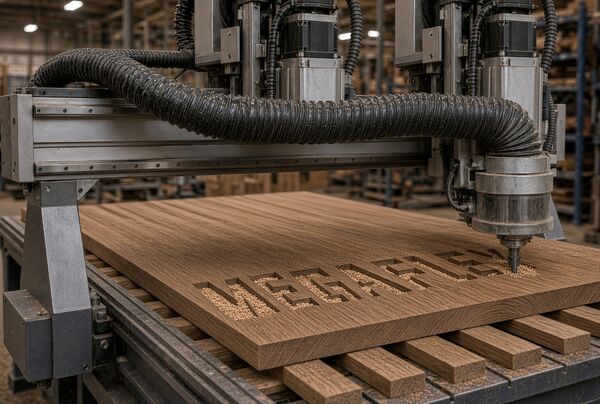
Whether you operate a high-speed multi-axis CNC router, a busy commercial joinery, or a dedicated cabinetmaking workshop, dust extraction is the lifeblood of your operation. Woodworking dust extraction is far more demanding than standard ventilation. Every cut, plane, and rout produces an abrasive stream of sharp timber shavings, coarse chippings, or sub-micron MDF dust particles travelling at velocities exceeding 20 to 28 metres per second. In addition, dry wood dust carries a severe risk of static spark ignition and catastrophic dust explosions.
Standard PVC ducting can quickly pinhole, crack from dynamic CNC gantry fatigue, or generate dangerous static arcs. This technical guide explains how to select the right extraction hose for CNC machining centres, planers, saws, sanders, and wood pellet transfer—balancing flexibility, abrasion resistance, ATEX antistatic safety, and fire retardancy.
Click here to skip to Step #1 of the step-by-step selection guide
Need assistance configuring your workshop duct run? Email our technical team at sales@megaflex.co.uk.
Which extraction hose should you choose for CNC router heads, planer-thicknessers, or bulk wood pellet silos?
Well, let’s dive in!
How to Select the Perfect Woodworking & CNC Hose in 6 Steps
- 1. Determine Inside Diameter, Velocity & Airflow (CFM). Size your duct bore to maintain minimum transport velocity (20–25 m/s) to prevent sawdust settling in horizontal runs, and match machine port dimensions.
- 2. Match Timber Media & Abrasiveness to Hose Wall Chemistry. Differentiate between fine airborne dust, coarse planer shavings, aggressive MDF/plywood resin binders, and bulk wood pellet delivery to pick between ester- and ether-based polyurethane.
- 3. Assess Static Dissipation & ATEX Combustible Dust Safety. Comply with TRGS 727 and ATEX directives by selecting permanently antistatic (AS) ducting with groundable spring steel wire to eliminate electrostatic spark risks.
- 4. Check Flame Retardancy Standards (DIN 4102-B1). Guard against workshop fires caused by friction sparks from blunt tooling or embedded nails by choosing certified flame-retardant ducting.
- 5. Account for Dynamic CNC Flex Fatigue & Crush Risks. Choose dedicated CNC ducting engineered for multi-axis gantry movement, or crush-recoverable hoses for high-traffic workshop floors.
- 6. Select the Proper Clamping & Fitting System. Secure corrugated ducting using specialised right- or left-hand bridge clamps that span external wire spirals to guarantee an airtight seal.
- Ready to pick your woodworking hose. Explore our application matrix and technical sizing table.
Why Invest in Dedicated Woodworking & CNC Extraction Ducting?
Wood dust is classified as an aggressive industrial media. Sharp, dry hardwood chips act as miniature cutting chisels against flexible walls, while synthetic adhesives in manufactured boards (MDF, chipboard, and plywood) create severe abrasive friction. Standard domestic vacuum hoses and unreinforced PVC ducting can wear through in weeks, collapse under negative extractor pressure, and create dangerous static charges. Investing in purpose-engineered polyurethane (PUR) extraction ducting extends hose life, maintains extraction efficiency, and protects your workshop from devastating dust fires and explosions.
The Operational Demands of Modern Woodworking Extraction:
- Extreme Abrasive Wear: Polyurethane provides up to 3 to 5 times the abrasion resistance of standard PVC and rubber compounds. A durable PUR liner withstands continuous scouring from knots, chips, and bark without thinning or perforating.
- ATEX Combustible Dust Hazards: Dry wood dust is an explosive fuel (Class ST1 / ST2). As millions of non-conductive wood particles collide with the inner wall, triboelectric friction builds thousands of volts of static charge. If not continuously grounded, static discharge can ignite airborne dust clouds inside the extraction duct or cyclone separator.
- High-Speed Multi-Axis CNC Fatigue: A modern CNC router head moves across X, Y, and Z axes at rapid traverse speeds (up to 30–60 m/min) thousands of times per shift. Standard ducting fatigues, kinks, and splits along the spiral weld. Dedicated CNC hoses are built with specialised corrugation profiles that absorb continuous multi-directional flexing without delaminating.
- Negative Vacuum Pressures: Central cyclones and high-vacuum baghouse extractors generate substantial suction. Ducting requires a high-tensile spring steel wire helix to prevent wall collapse while remaining lightweight enough not to drag on automated gantries.
Benefits of Specifying Premium Polyurethane Ducting:
- Reduce Fire and Explosion Risks: Certified compliance with TRGS 727 and DIN 4102-B1 ensures safe static grounding and self-extinguishing fire protection.
- Optimise Airflow & Cut Energy Bills: Smooth internal bores reduce air turbulence and friction losses, allowing extraction units to capture fine dust at the tool head using less fan power.
- Eliminate Machine Downtime: Prevent split hoses from halting production runs, dropping extraction suction, and covering expensive CNC linear guides in abrasive sawdust.
- Step-Proof Workshop Floors: Selecting crush-recoverable ducting prevents hoses from being ruined when stepped on by operators or run over by board carts.
Ready to upgrade your workshop extraction lines? Review our step-by-step selection guide or contact our technical team at sales@megaflex.co.uk.
Step-by-Step Guide to Selecting the Right Woodworking Hose
Step 1: Determine Inside Diameter, Velocity & Airflow (CFM)
Duct sizing directly controls particle suspension, static pressure, and collection efficiency:
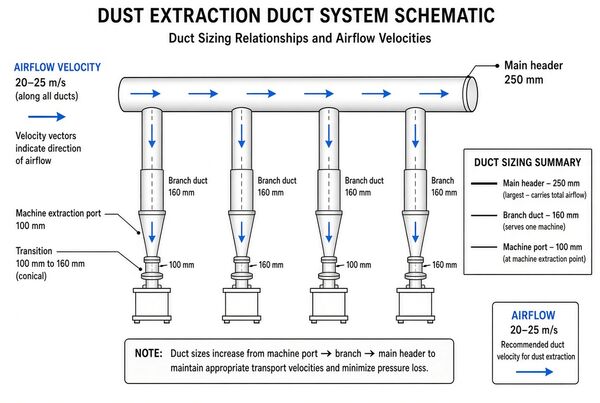
- The Velocity Rule (20–25 m/s): To keep timber waste entrained in the airstream and prevent sawdust from dropping out of suspension and choking horizontal duct runs, air velocity must remain between 20 m/s and 25 m/s (approx. 4,000 to 5,000 FPM). For damp shavings or green timber, velocity should be increased toward 25–28 m/s.
- Inside Diameter (ID) Matching: Always size the flexible drop hose to match the extraction port on your machine:
- 50 mm to 63 mm (2" to 2.5"): Handheld power tools, small router tables, and compact CNC engravers.
- 80 mm to 100 mm (3.15" to 4"): Standard CNC router hoods, 10" table saws, band saws, and spindle moulders.
- 125 mm to 150 mm (5" to 6"): 12"–16" table saws, edgebanders, wide-belt sanders, and single-surface planers.
- 160 mm to 250 mm (6.3" to 10"): Multi-head moulders, 4-sided planers, primary CNC manifold drops, and central cyclone headers.
- Avoid Abrupt Reductions: Choking a 150 mm machine outlet down to a 100 mm flexible hose with a stepped reducer creates extreme static pressure resistance, drastically reducing CFM and leaving fine dust at the cutter head.
Step 2: Match Timber Media & Abrasiveness to Hose Wall Chemistry
Different woodworking processes generate distinct waste streams that require specific polymer wall chemistries:
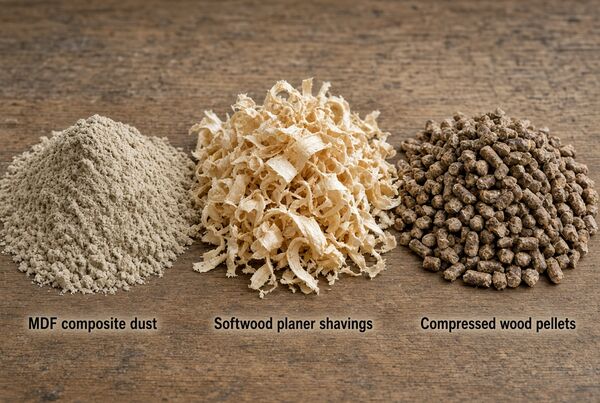
Fine Dust vs. Coarse Chips vs. MDF Composites
Sanding and cutting generate fine, powdery dust that requires smooth, lightweight ducting with tight bend radii. Conversely, thicknessers, multi-blade rip saws, and wood chippers produce coarse, high-volume shavings that strike the hose wall with high kinetic energy, demanding a heavier wall thickness (0.7 mm to 1.5 mm). Machining MDF, chipboard, and engineered composite panels is particularly demanding: the cured urea-formaldehyde and melamine resin binders act like fine sandpaper, requiring high-grade polyurethane like TIMBERDUC® PUR 532 CNC

Ester-Based Polyurethane vs. Ether-Based Polyurethane:
- Ester-Based Polyurethane (e.g., OZ01


- Ether-Based Polyurethane (e.g., 532-2533


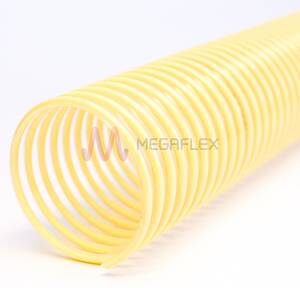
- Bulk Wood Pellet Suction & Delivery: Pneumatically filling wood pellet biomass hoppers requires specialised, heavy-duty suction hoses such as the Ether Polyurethane Suction Hose

Step 3: Assess Static Dissipation & ATEX Combustible Dust Safety
Static control is a mandatory safety requirement in modern woodworking extraction:
Wood dust is combustible. When non-conductive wood particles travel through an ungrounded plastic pipe at high velocity, triboelectric friction can charge the ducting to thousands of volts. A single discharge spark can ignite airborne sawdust clouds, causing an explosive deflagration. Compliance with TRGS 727 (technical rules for dangerous substances) and European ATEX directives is essential for extraction safety.
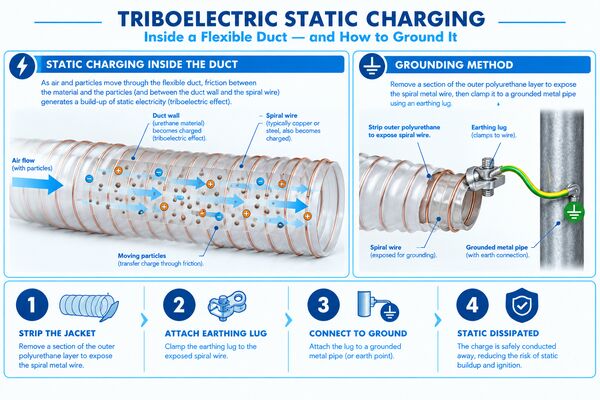
Methods of Static Grounding in Polyurethane Ducting:
- Permanent Antistatic (AS) Wall Material: Premium ducting—such as TIMBERDUC® PUR 531 AS

- Grounding the Spring Steel Wire Spiral: To achieve complete ATEX compliance, the high-tensile spring steel wire helix must be stripped back at each connection end and grounded to the metal extraction ductwork or machine chassis using conductive grounding clamps. This provides a direct, uninterrupted path to earth (R ≤ 10⁴ Ω).
- Avoid Temporary Spray Treatments: Never rely on topical antistatic sprays or loose internal copper wires threaded through non-conductive PVC hose. Loose wires catch shavings, cause blockages, and create friction heat.
Step 4: Check Flame Retardancy Standards (DIN 4102-B1)
Friction sparks from machine tooling are a primary source of workshop extraction fires:
When a circular saw, spindle moulder, or wide-belt sander strikes an embedded nail, staple, or hard timber knot, incandescent sparks are pulled directly into the extraction duct. Standard plastic hoses ignite easily, spreading fires through ceiling ductwork into central baghouses.
- DIN 4102-B1 Certified Flame Retardant: Hoses such as TIMBERDUC® PUR 531 AS


- Self-Extinguishing Performance: If ignited by a passing spark, DIN 4102-B1 certified polyurethane halts flame propagation and extinguishes itself once the heat source is removed, preventing the fire from travelling along the duct run.
Step 5: Account for Dynamic CNC Flex Fatigue & Crush Risks
Physical machinery movements place continuous mechanical stresses on extraction lines:
Multi-Axis Dynamic Flex Fatigue on CNC Routers
CNC gantries accelerate, decelerate, twist, and curve continuously along 3-axis, 4-axis, and 5-axis toolpaths. Conventional spiral ducting fatigues rapidly, tearing the thin film membrane between wire ribs. The TIMBERDUC® PUR 532 CNC Polyurethane Ducting
Shop Floor Traffic & Crush Recoverability
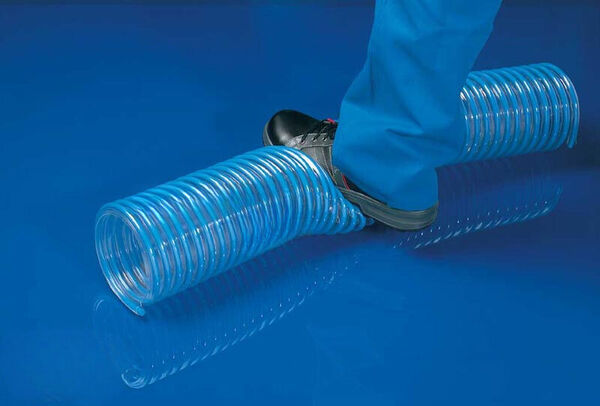
Hoses running across workshop floors to standalone joinery benches, morticers, or mobile vacuum units are vulnerable to being stepped on or crushed by timber carts. Conventional wire-helix hoses deform permanently when crushed, choking airflow:
- Master-PUR STEP Crush-Recoverable Ducting

- Abrasion Resistant Vacuum Hose


Step 6: Select the Proper Clamping & Fitting System
A high-performance extraction hose requires a secure, airtight connection:
- Bridge Clamps (Spiral Hose Clamps): Flexible woodworking ducting features a corrugated outer surface created by the internal steel helix. Standard flat worm-drive clips pinch against the raised wire, creating air gaps on either side that hiss, leak suction, and drop velocity. Bridge Clamps feature an engineered bridge arch that steps cleanly over the raised spiral helix, applying 360° uniform radial compression around the underlying polyurethane cuff for a leak-free seal.
- Direction of Spiral (Right-Hand vs. Left-Hand): Always verify the pitch direction of your duct's wire helix (most TIMBERDUC® and polyurethane ductings feature a right-hand pitch) to ensure your bridge clamp seats properly.
- Quick-Release Couplings & Galvanised Reducers: Use smooth, tapered galvanised steel reducers and quick-release lever clamps to transition between rigid spiral-wound spiral duct mains and flexible drops, keeping internal step turbulence to a minimum.
Why Choosing the Right Woodworking Hose Matters
Using improper, generic, or non-certified ducting in woodworking operations leads to serious issues:
- Catastrophic Workshop Fires: Sparks hitting flammable, non-certified PVC ducting can ignite airborne sawdust clouds, leading to rapid fire spread through extraction lines.
- Loss of Extraction Efficiency: Choked, kinked, or leaking hoses drop CFM at the tool head, leaving fine carcinogenic hardwood dust (oak, beech) in the workshop air.
- Frequent Line Failures: Rapid flex fatigue on CNC heads causes standard hoses to split along the spiral seam, creating unexpected downtime during high-value production runs.
- Premature Wear on MDF Lines: Thin, generic duct walls wear through in weeks under the abrasive scouring of abrasive MDF dust binders and sharp wood shavings.
Ready to Choose Your Woodworking Hose?
Follow this checklist when ordering extraction ducting for your joinery or CNC shop:
- Identify the Machine: Determine whether the line is for a dynamic CNC gantry, a stationary planer, a sanding bench, or a wood pellet hopper.
- Check Airstream Velocity & ID: Measure machine exhaust spigots and ensure inside diameter maintains 20–25 m/s transport speed.
- Verify Antistatic & Fire Ratings: Confirm permanent antistatic properties (R < 10⁹ Ω) and DIN 4102-B1 flame retardance.
- Match Wall Thickness to Media: Specify 0.4 mm to 0.7 mm for fine dust and CNC heads; 0.9 mm to 1.5 mm for coarse chips, planings, and MDF.
- Order Compatible Bridge Clamps: Ensure bridge clamps match the diameter and spiral pitch of the selected ducting.
Top Hose Picks for Woodworking & CNC Applications
To assist in specifying equipment for your workshop, our extraction hoses are categorised below by operational duty:
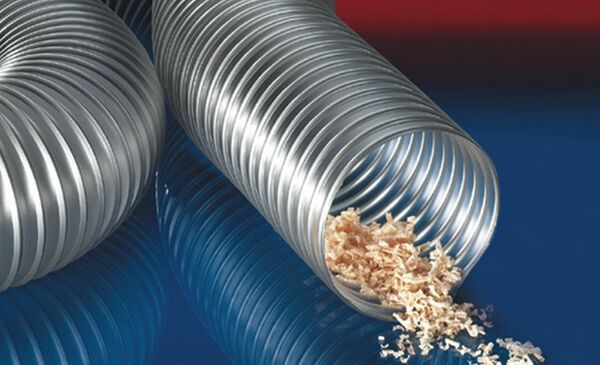
The TIMBERDUC® PUR 532 CNC
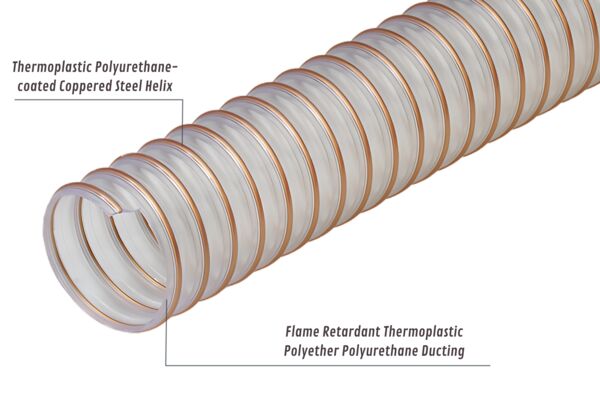
High-volume waste streams from 4-sided planers, spindle moulders, and thicknessers require increased wall thickness to resist particle impact. The Vulcano 09 AF

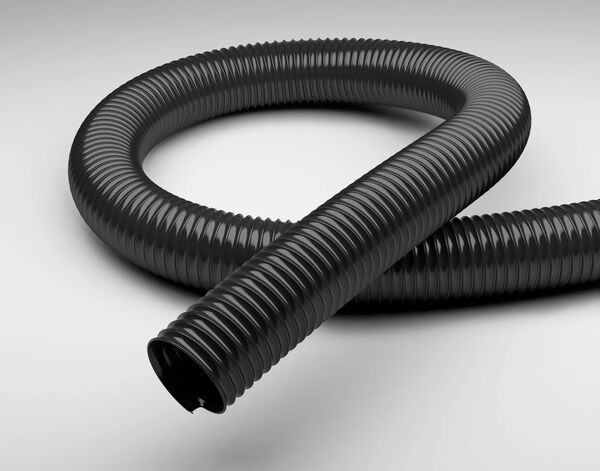
Where strict fire insurance and building codes govern workshop operations, the Flamex BF-SE Flame Resistant PU Ducting
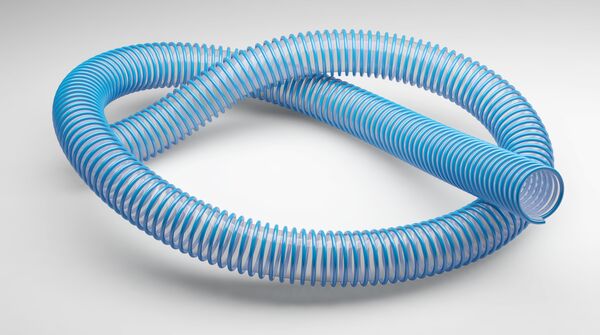
Extraction lines laid across workshop walkways are often damaged by foot traffic or loaded hand trucks. The Master-PUR STEP Crush-Recoverable Ducting
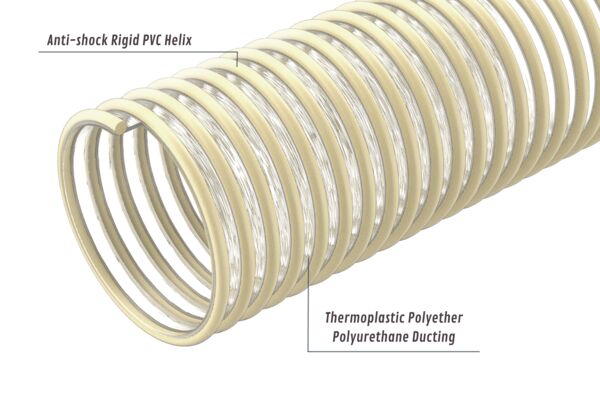
Pneumatic transfer of compressed wood pellets to domestic or industrial biomass boilers requires heavy-duty suction and delivery hoses that can handle high friction. The Ether Polyurethane Suction Hose
Woodworking & CNC Ducting Technical Specifications
The table below provides technical data for our primary woodworking and CNC extraction ductings:
| Ducting / Hose Series | Wall Thickness (mm) | Polymer Chemistry | Temperature Range | Flame Retardancy Rating | Antistatic Performance | Primary Woodworking Application |
|---|---|---|---|---|---|---|
| TIMBERDUC® PUR 532 CNC | 0.6 mm (Optimised) | Ether Polyurethane | -40°C to +90°C | DIN 4102-B1 Certified | Permanent AS (R < 10⁹ Ω) | Multi-axis CNC router heads, high dynamic flex gantries |
| TIMBERDUC® PUR 531 AS | 0.4 mm | Ether Polyurethane | -40°C to +90°C | DIN 4102-B1 Certified | Permanent AS (R < 10⁹ Ω) | Lightweight extraction, table saws, stationary joinery |
| Vulcano 09 AF | 0.9 mm | Ester Polyurethane | -40°C to +90°C | DIN 4102-B1 Certified | Groundable steel spiral | Planers, thicknessers, multi-blade rip saws, MDF dust |
| Next 15 Clear PU | 1.5 mm (Heavy) | Ether Polyurethane | -40°C to +90°C | UL 94-V2 | Groundable steel spiral | Heavy timber chippings, abrasive bark, central collector drops |
| Master-PUR STEP | Reinforced Profile | Polyurethane Hybrid | -40°C to +90°C | Flame Retardant | Antistatic Wall | Crush-recoverable floor lines, joinery workshop walkways |
| Flamex BF-SE | 0.5 mm | Polyurethane Compound | -40°C to +90°C | DIN 4102-B1 Certified | Groundable wire spiral | Strict fire safety joinery lines, sawmills, automated plants |
| AIRDUC® PUR 355 AS | 1.4 mm – 1.5 mm | Ether Polyurethane | -40°C to +90°C | DIN 4102-B1 Certified | Permanent AS (R < 10⁹ Ω) | Abrasive MDF routing, central dust collection mains |
| Ether PU (ZE01) | Heavy Duty Suction | Ether Polyurethane | -40°C to +90°C | Abrasion Resistant | Groundable wire/helix | Bulk wood pellet delivery, biomass boiler charging |
Which Extraction Hose Is Right for Your Shop? For high-speed CNC router gantries, the TIMBERDUC® PUR 532 CNC is the primary choice due to its dynamic flex geometry and DIN 4102-B1 fire certification. For heavy planer-thicknessers, choose the 0.9 mm Vulcano 09 AF. For areas where floor runs get stepped on, specify the Master-PUR STEP. For wood pellet silos, use the heavy-duty Ether PU (ZE01). Need assistance matching duct sizes or selecting bridge clamps? Email sales@megaflex.co.uk.
Final Thoughts
Efficient, safe dust extraction is essential for clean cuts, extended tool life, and workplace safety in modern woodworking. Installing high-grade polyurethane ducting with verified DIN 4102-B1 flame retardance, TRGS 727 antistatic compliance, and properly seated bridge clamps protects your equipment and your personnel from catastrophic dust explosions and workshop fires. By matching your ducting to the exact waste volume, particle abrasiveness, and machinery movement of your workshop, you ensure an efficient, reliable extraction system. Looking for advice or a tailored quotation? Contact our technical team today at sales@megaflex.co.uk!
Check Out Our Other Blogs
Explore our other technical articles and practical industrial guides:
- Eolo PU Ducting: The Ultimate Solution for Food-Grade Material Transfer
- Conduits at Megaflex: Material Matters
- How to Select the Perfect Hose for Your Needs in 2026
- How to Calculate Bend Radius: A Comprehensive Guide
Visit our blog homepage for more practical insights!
Woodworking & CNC Extraction Hose Frequently Asked Questions (FAQ)
Have questions about sizing, grounding, or specifying extraction ducting for your woodworking machinery? Click any question below to see the answer. For custom assemblies and technical recommendations, contact our team at sales@megaflex.co.uk!
Click a question to read the answer:
Standard PVC has low abrasion resistance and wears through quickly when exposed to abrasive hardwood chips and MDF dust. Furthermore, standard PVC is non-conductive and builds up high static charges that cannot be safely dissipated, creating significant static shock hazards and dust explosion risks. PVC also burns easily and releases toxic fumes if exposed to friction sparks.
Dedicated CNC ducting—such as the TIMBERDUC® PUR 532 CNC—features an engineered corrugation profile and high-tensile spring steel wire designed for dynamic, multi-directional flexing. Standard ducting fatigues rapidly under continuous 3-axis gantry movement, cracking along the spiral weld. CNC-grade ducting withstands millions of rapid flex cycles without delaminating or kinking.
Static builds via triboelectric friction as dry sawdust particles rub against the non-conductive duct wall at speeds of 20–25 m/s. It is safely controlled by using permanently antistatic polyurethane ducting (rated R < 10⁹ Ω under TRGS 727) and grounding the internal spring steel wire helix to the metal ductwork or machine earth at both ends.
DIN 4102-B1 is a European flammability standard designating building materials with low flammability. When a blunt tool or embedded nail strikes timber, sparks enter the extraction duct. A DIN 4102-B1 certified polyurethane duct is self-extinguishing and will not spread fire through the ceiling ductwork into central baghouse collectors.
Flexible polyurethane ducting has a corrugated outer surface created by the internal spiral wire. Standard flat hose clips bridge across the wire, pinching the wall and leaving gaps on either side that leak vacuum pressure and whistle. Bridge clamps feature a pre-formed arch that spans cleanly over the spiral wire, delivering uniform 360° compression around the duct cuff for an airtight seal.
Ester-based polyurethane provides the highest tensile strength and superior dry mechanical abrasion resistance, making it ideal for dry indoor sawdust and planer shavings. Ether-based polyurethane is completely resistant to hydrolysis and microbial decay, making it essential for moist timber, unseasoned wood, outdoor silos, or unheated workshops where standing damp can degrade ester polymers.
A minimum velocity of 20 m/s (approx. 4,000 FPM) is required for dry sawdust and shavings to prevent waste from settling in horizontal duct sections. For heavier green timber chips or damp planings, transport velocity should be maintained between 25 m/s and 28 m/s.
Yes. The Master-PUR STEP ducting is designed specifically for floor runs subject to foot traffic or hand cart wheels. Its unique wall profile and polymer construction allow it to spring back to full round diameter immediately after being crushed, preventing permanent flat-spotting and airflow blockages.
Pneumatic transfer of dense, abrasive wood fuel pellets requires heavy-duty suction and delivery hoses such as the Ether PU (ZE01) or NORPLAST® PVC 387 Antiabrasivo. These hoses feature smooth internal bores and integrated grounding wires to resist pellet friction and dissipate static charges during bulk tanker discharge.
Use 0.4 mm to 0.6 mm wall ducting (such as TIMBERDUC® 531 AS or 532 CNC) for fine dust, table saws, and moving CNC router heads where high flexibility is paramount. For high-impact waste from planers, thicknessers, and abrasive MDF machining, select heavier 0.9 mm to 1.5 mm ducting (such as Vulcano 09 AF or Next 15 PU) for extended service life.