Anti-Static, Conductive, Insulative, Flame-Retardant or ATEX: What Hose Do I Need?
Updated September 21, 2026
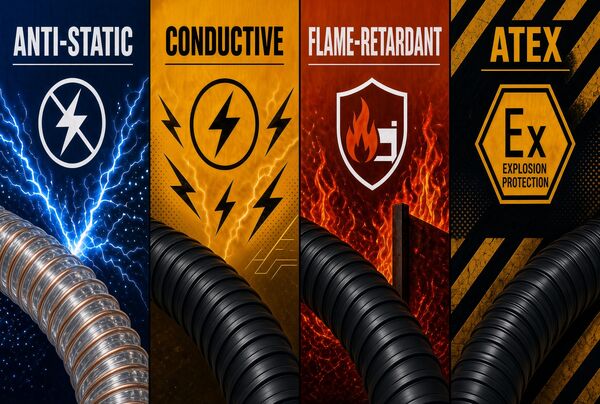
When specifying industrial hoses and flexible ducting, safety classifications can easily become confusing. Terms like standard, anti-static, electrically conductive, flame-retardant, and ATEX-certified are frequently mixed up, yet each addresses a distinct physical hazard. Using an untreated standard PVC hose to transfer combustible grain or solvent fumes can cause catastrophic static spark discharges and dust explosions. Conversely, assuming an anti-static hose is automatically fireproof can result in rapidly spreading conveyor fires.
This definitive guide demystifies the physics of electrical resistance, combustible dust hazards (DSEAR / ATEX), and flammability standards—helping you select the exact level of protection required for your facility.
Click here to skip to Step #1 of the step-by-step walkthrough.
How do you know whether your application requires standard plastic, static dissipation, full electrical conductivity, or certified flame retardance?
Well, let’s dive in!
How to Determine Your Hose Safety Rating in 6 Steps
- 1. Understand the Electrical Resistance Spectrum. Learn the physical difference between insulating (R ≥ 1012 Ω), anti-static (109 Ω ≤ R< 1012 Ω), and electrically conductive (R< 106 Ω) materials.
- 2. Identify Your Carried Media & Minimum Ignition Energy (MIE). Differentiate between non-flammable ambient air, combustible wood/grain dusts (ST1 / ST2), and volatile hydrocarbon solvents.
- 3. Map Your DSEAR / ATEX Operating Zones. Determine whether your installation sits in an unclassified zone or an ATEX Zone 0/20, 1/21, or 2/22 explosive atmosphere under TRGS 727.
- 4. Debunk the Myth: Anti-Static vs. Flame Retardant. Recognise why static dissipation does not equal fire resistance, and when certified DIN 4102-B1 or UL 94 flammability protection is mandatory.
- 5. Choose Between Inherently Conductive Walls & Groundable Wire Helices. Select between carbon-black loaded compounds and clear antistatic polymers grounded via high-tensile spring steel spirals.
- 6. Select the Compatible Earthing & Clamping System. Ensure total electrical continuity to earth using dedicated bridge clamps, copper grounding leads, and conductive metal couplings.
- Ready to select your hose. Explore our safety-categorised product range and engineering comparison table.
Why Choosing the Right Safety Classification Matters
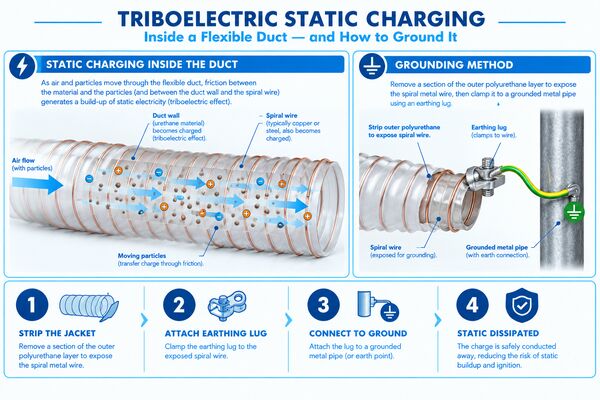
Industrial transfer lines are dynamic environments. When dry powders, plastic granules, wood shavings, or abrasive blasting media flow through a pipe at high velocities (15 to 30 m/s), friction continuously strips electrons from the carried particles. This phenomenon—known as triboelectric charging—can build electrostatic potentials exceeding 20,000 to 30,000 volts in minutes. Without a designated electrical path to earth, an electrostatic discharge spark will arc to the nearest grounded structure, instantly igniting flammable dust clouds or solvent vapours.
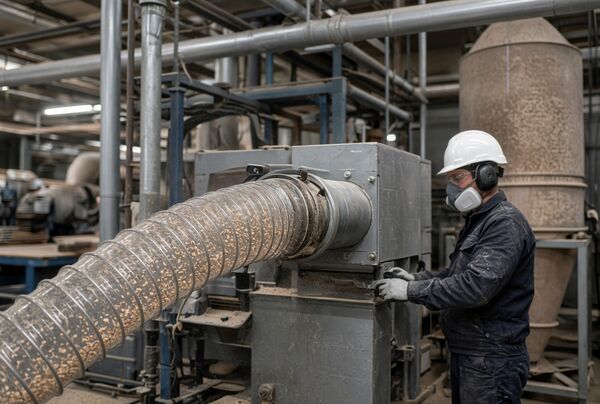
The Real Hazards of Specifying the Wrong Hose:
- Combustible Dust Explosions (ATEX / DSEAR): Organic dusts (flour, grain, sugar, wood, cocoa) and synthetic powders (resins, toner, aluminium flake) are violently explosive when suspended in air. A single static discharge inside an extraction line can trigger an explosion that propagates through ductwork to central collectors.
- Operator Shocks & Involuntary Accidents: When transferring materials through ungrounded plastic hoses, operators holding the line receive painful capacitive shocks. In elevated shipyard or construction environments, secondary shock reactions frequently cause falls from heights.
- Pinhole Wall Burn-Through: High-voltage static charges trapped inside non-conductive plastic hoses will arc directly through the hose carcass to external metal machinery, burning microscopic pinholes that compromise vacuum suction and leak toxic dust.
- Rapid Fire Propagation: Standard thermoplastics act as solid petroleum fuels. If an extraction line pulls in an incandescent friction spark from a saw blade or grinding wheel, non-flame-retardant ducting will catch fire and spread flames throughout the building's ceiling void.
The Benefits of Proper Engineering Specification:
- Zero Electrostatic Accumulation: Safely dissipate static charges to ground before electrical potentials reach the Minimum Ignition Energy (MIE) of your process media.
- Full Regulatory Compliance: Satisfy UK DSEAR (Dangerous Substances and Explosive Atmospheres Regulations) and European ATEX 2014/34/EU audits with certified documentation.
- Self-Extinguishing Fire Protection: Certified flame-retardant compounds halt fire spread immediately once external sparks extinguish, protecting capital extraction assets.
Ready to verify your safety specifications? Follow our step-by-step selection guide or contact our technical engineers at sales@megaflex.co.uk for project advice.
Step-by-Step Guide to Hose Safety Classifications
Step 1: Understand the Electrical Resistance Spectrum
The ability of a hose or duct to dissipate static electricity is governed by its electrical surface and volume resistivity, measured in Ohms (Ω) in accordance with BS EN ISO 8031:
- 1. Insulating / Standard Materials (R ≥ 1012 Ω): Standard, untreated PVC, polyurethane, and rubber hoses. These materials cannot conduct or dissipate electrical charges. Static charges generated inside remain trapped on the plastic surface indefinitely. Suitable only for non-flammable liquids (water, mild sewage), non-combustible gases, and low-risk ventilation where no explosive dust or vapor is present.
- 2. Anti-Static / Static Dissipative (109 Ω ≤ R< 1012 Ω or R< 109 Ω): Materials formulated with static-dissipative additives (such as the TIMBERDUC® PUR 531 AS


- 3. Electrically Conductive (R< 106 Ω, typically R ≤ 104 Ω): Highly conductive materials compounded with conductive carbon black, graphite, or metallic particles (such as the Conductive Rubber Shotblast Hose

Step 2: Identify Your Carried Media & Minimum Ignition Energy (MIE)
The physical and chemical state of the conveyed material dictates the required electrical rating:
Clean Air & Non-Combustible Waste (Standard Hoses)
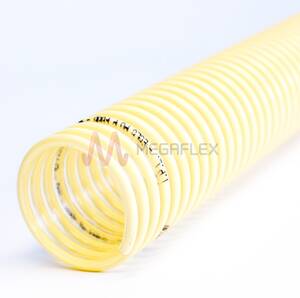
If you are moving clean ambient air, non-flammable water, gravel, wet cement slurry, or inert extraction fumes (where dust concentration is below combustible limits), a standard, non-antistatic hose like Food Quality Polyurethane Ducting
Combustible Dusts & Dry Granules (Anti-Static Required)
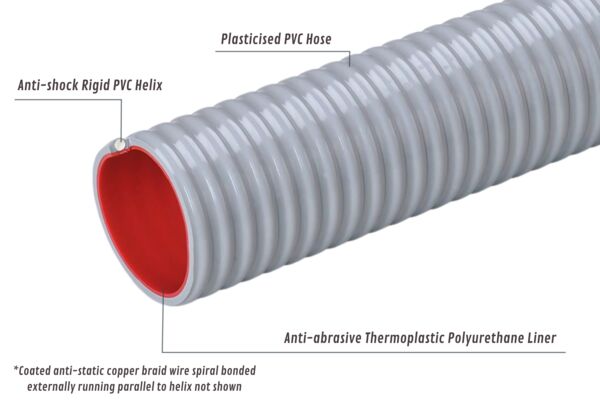
Woodworking dust, flour, starch, plastic pellets, grain, sugar, and coal dust have a defined Minimum Ignition Energy (MIE). If an electrostatic spark exceeds this energy threshold (often as low as 1 to 10 milliJoules), the dust cloud will ignite. These applications require anti-static polyurethane ducting—such as Eolo PU Food AS Antistatic Ether-PU Ducting

Flammable Solvents, Hydrocarbons & Paints (Electrically Conductive Required)
Acetone, toluene, alcohols, petrol, and solvent-based paints generate highly volatile vapours with exceptionally low MIE values (< 0.2 mJ). Vapours can be ignited by the faintest micro-spark. These lines demand fully conductive hoses (R< 106 Ω), such as the Master-PUR H-EL Electrically Conductive PU Ducting

Step 3: Map Your DSEAR / ATEX Operating Zones
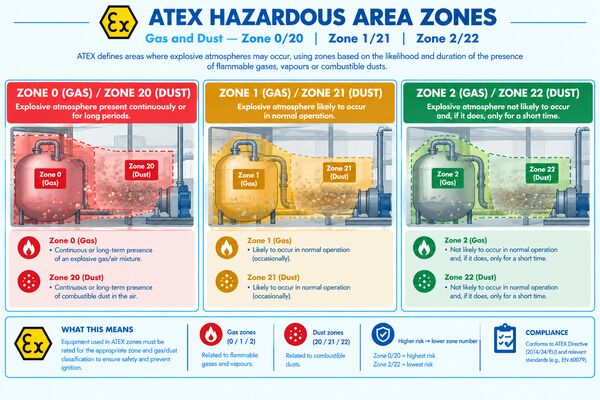
Under European ATEX Directive 2014/34/EU and UK DSEAR legislation, manufacturing facilities must classify hazardous areas into zones based on explosion frequency and duration:
- Zone 0 (Gas) / Zone 20 (Dust): An explosive atmosphere is present continuously or for long periods (>1,000 hours/year). Inside of storage silos, cyclone separators, and solvent tanks. Requirement: Strictly Electrically Conductive hoses (R< 106 Ω) with metallic bonding to earth.
- Zone 1 (Gas) / Zone 21 (Dust): An explosive atmosphere is likely to occur in normal operation (10 to 1,000 hours/year). Immediate extraction hoods, paint spray booths, and mill discharge chutes. Requirement: Electrically Conductive or TRGS 727 compliant permanently Antistatic ducting (R< 109 Ω) with both ends of the spiral grounded.
- Zone 2 (Gas) / Zone 22 (Dust): An explosive atmosphere is not likely to occur in normal operation, or persists for only a short period (<10 hours/year). General workshop extraction lines, secondary filter lines, and warehouse storage areas. Requirement: Antistatic ducting with groundable wire spirals or static-dissipative wall compounds.
Step 4: Debunk the Myth: Anti-Static vs. Flame Retardant
One of the most dangerous misconceptions in industrial specification is assuming that an anti-static hose is automatically flame retardant:
Anti-Static Controls Sparks; Flame Retardance Controls Fire
An anti-static hose prevents electrical charges from generating an ignition spark. However, the base polymer (such as standard polyethylene or untreated polyurethane) remains flammable. If an external flame or glowing ember enters the duct, an untreated anti-static hose will burn vigorously.
Understanding Fire Ratings (DIN 4102-B1 & UL 94)
A flame-retardant hose is formulated with specialised chemical additives that actively suppress combustion, prevent flame propagation, and protect extraction systems from fire:
DIN 4102-B1 is a prominent German and European standard that assesses the fire behaviour of building and industrial materials, classifying them as schwerentflammbar (hardly flammable / low flammability). In extraction ducting, a B1 rating certifies that the material will not readily ignite from heat or incidental sparks, will self-extinguish once the ignition source is removed, and will not sustain flame spread through the duct run. In comparison, UL 94 is a global standard developed by Underwriters Laboratories that tests the flammability and burning behaviour of plastics in horizontal and vertical orientations. In industrial hoses, vertical ratings such as UL 94-V2 and UL 94-V0 specify how quickly a plastic extinguishing flame ceases (within 10 to 30 seconds) and whether burning droplets are permitted, with V-0 providing the highest level of self-extinguishing flame resistance without flaming drips.
- DIN 4102-B1 Certified: European standard designating materials with low flammability. Products such as Vulcano 09 AF


- Dual-Rated Protection (The Gold Standard): For woodworking, laser cutting, and metal grinding extraction where both combustible dust AND incandescent sparks are present, specify a dual-certified hose that is BOTH permanently antistatic AND flame-retardant (such as TIMBERDUC® PUR 531 AS

Step 5: Choose Between Inherently Conductive Walls & Groundable Wire Helices
Electrical continuity can be achieved through two distinct manufacturing approaches:
1. Groundable Spiral Wire Reinforcement (Clear / Translucent Ducting)
Most industrial polyurethane ductings feature a high-tensile spring steel or copper-coated wire helix embedded between the plastic plies. In these designs:
- The polymer wall is formulated with permanent antistatic additives (R< 109 Ω).
- To dissipate accumulated charges, the metallic helix must be stripped bare at each end and mechanically grounded to the metal pipework or machine chassis.
- Advantage: Allows transparent walls for visual inspection of material flow and blockages, while maintaining TRGS 727 antistatic compliance.
2. Inherently Conductive Carcass Compounds (Black Rubber / Carbon Filled)
In hoses such as the Conductive Rubber Shotblast Hose
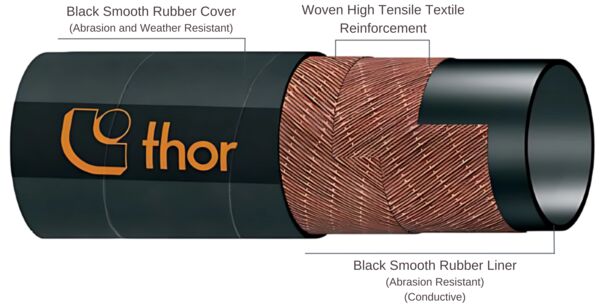
- The entire rubber or plastic compound is saturated with conductive carbon black particles (R< 106 Ω).
- Charges migrate directly through the wall mass. Connecting the hose to a metal coupling automatically creates an electrical circuit without stripping wires.
- Advantage: Maximum safety in solvent, chemical, and fuel transfer where wire breakage cannot be tolerated.
Step 6: Select the Compatible Earthing & Clamping System
An anti-static or conductive hose provides zero protection if it is not properly connected to electrical earth:
- Earthing the Spiral Wire: When fitting polyurethane ducting, strip back 20–30 mm of the plastic outer wall to expose the internal steel wire. Fold the exposed wire back against the outside cuff of the duct, or attach an earthing eyelet.
- Bridge Clamps with Grounding Pigtails: Standard band clamps bridge over spiral corrugations, leaking air. Use Bridge Clamps that step over the wire spiral. Ensure metal-to-metal contact between the exposed wire, clamp body, and grounded metal spigot.
- Conductive Gaskets & Safety Clips: In shotblasting and chemical transfer, pair conductive hoses with malleable iron or stainless steel couplings. Ensure rubber face gaskets do not insulate the connection, and use bonding jumper cables across hose joints to maintain continuity below 100 Ω.
- Verification with an Ohmmeter: Always test newly installed hose assemblies with an electrical resistance meter (megohmmeter) before commissioning to verify total resistance to earth complies with ATEX / DSEAR specifications.
Why Proper Safety Specification Matters
Mismatched safety ratings can lead to severe industrial accidents:
- Dust Explosions: Untreated PVC hoses collecting combustible dust can arc static sparks, triggering deflagrations inside central extraction systems.
- Ductwork Fires: Using flammable anti-static hoses on saws or grinding benches allows sparks to ignite the duct, spreading fire throughout the factory roof space.
- Solvent Flash Fires: Transferring volatile solvents through non-conductive lines generates static discharges that ignite flammable air-vapour mixtures.
- Failed Insurance Audits: Operating uncertified hoses in classified DSEAR zones can void industrial property insurance following an incident.
Ready to Choose Your Safety Hose or Ducting?
Follow this checklist when selecting your industrial transfer lines:
- Classify the Media: Is the conveyed product non-flammable air/water, combustible dust, or volatile solvent vapour?
- Check the MIE: Does the powder have a Minimum Ignition Energy under 10 mJ? (If yes, specify anti-static or conductive).
- Determine the ATEX Zone: Confirm whether the area is Zone 0/20, Zone 1/21, or Zone 2/22.
- Assess Fire Risks: Are hot sparks, welding spatter, or cutting friction present? (If yes, specify DIN 4102-B1 flame retardance).
- Verify Earthing Procedures: Confirm whether the installation allows manual wire spiral grounding or requires an inherently conductive carcass.
Top Picks by Safety Classification
To assist in specifying equipment for your facility, our hoses and ductings are categorised below by safety profile:
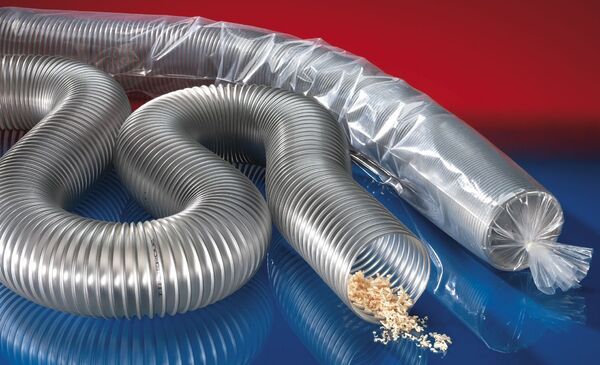
The TIMBERDUC® PUR 531 AS
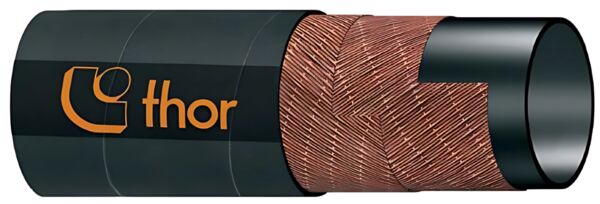
Where extreme static dissipation is required without relying on internal grounding wires, the Conductive Rubber Shotblast Hose
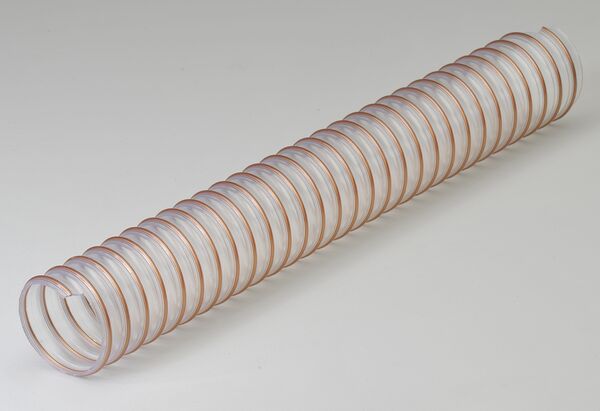
For applications where burning embers and sparks present severe fire risks, the Vulcano 09 AF
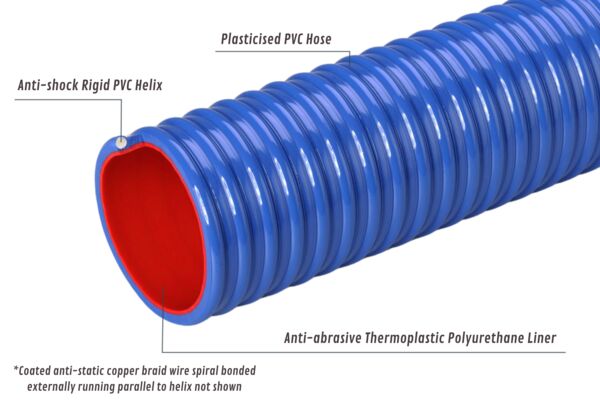
Vacuum extraction of heavy abrasive media, spent shot, and bulk grain creates intense static charges under full negative pressure. The Urano HD Super AS Antistatic PVC S&D Hose with Red Inner Ester-PU with Rigid PVC Helix (Ultra-Heavy Duty)
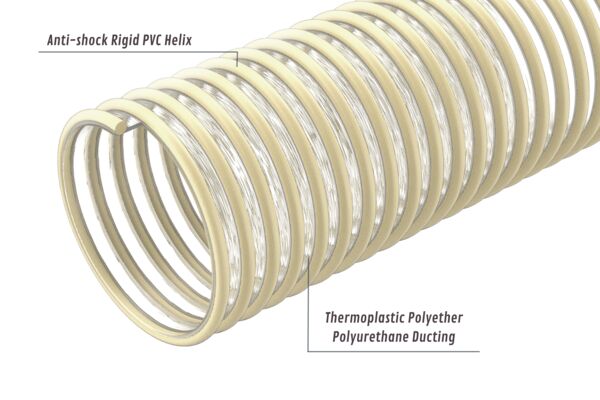
For operations where conveyed media is entirely non-combustible—such as ambient warm air transfer, non-reactive ventilation, and non-flammable food handling—standard untreated polyurethane ducting such as Food Quality Polyurethane Ducting
Engineering Comparison: Hose Safety Classifications
The table below provides a comprehensive comparison of electrical resistance, flammability standards, and ATEX zone suitability across all hose categories:
| Classification | Electrical Resistance (R) | Flame Retardance Standard | Primary Media Handled | ATEX / TRGS 727 Zone Suitability | Example Megaflex Product |
|---|---|---|---|---|---|
| Standard / Insulative | R ≥ 1012 Ω (Insulative wall) | None (Standard combustible) | Dry bulk foodstuffs, grains, sugar, animal feed, clean air ventilation | Non-ATEX / Unclassified (Not permitted in explosive zones) | Food Quality PU (EU01) |
| Heavy-Duty Anti-Static (AS) | R< 109 Ω (Vol. res. < 2.5 × 10⁸ Ω·m) | DIN 4102-B1 & UL 94-V2 | High-throughput abrasive bulk solids, plastic granulates, sand, gravel, wood pellets | Dust: Zones 20, 21, 22 (Pneumatic transport inside); Zone 22 (Aspiration) Gas: Zones 1 & 2 (when wire earthed); Flammable liquids inside Zones 0, 1, 2 | AIRDUC® PUR 355 AS |
| Electrically Conductive (EC) | R< 103 Ω | None | Abrasive media (dust, chips, oil mist, gas, powder, paper, textile fibres) | Gas: Zones 0, 1, 2 Dust: Zones 20, 21, 22 (when earthed via conductive couplings) | Master-PUR H-EL Electrically Conductive PU Ducting |
| Flame Retardant (FR) | Insulative wall (R ≥ 1012 Ω); Conductive spiral (R ≤ 102 Ω/m) | UL 94-V0 Certified | Welding fumes, grinding sparks, furnace exhaust, hot non-explosive dust | Non-ATEX (Spark & fire protection only; not approved for ATEX dust/gas zones) | Vulcano 09 AF (U901) |
| Dual-Rated (AS + FR) | R< 109 Ω + Groundable steel wire | DIN 4102-B1 Certified | Combustible wood dust, timber shavings, CNC router extraction, joinery sawmills | Dust: Zone 22 inside (Aspiration of combustible dust) Gas: Zones 1 & 2 (when wire earthed) | TIMBERDUC® PUR 531 AS |
Summary Recommendation: When moving dry organic powders or timber dust, always specify an Anti-Static hose with a groundable wire helix. If incandescent sparks are possible, ensure it is also certified DIN 4102-B1 Flame Retardant. For flammable liquids, vapours, or ATEX Zone 0/20 zones, strictly select an Electrically Conductive (R< 106 Ω) hose. For unclassified ambient ventilation, a Standard hose provides an economical solution.
Final Thoughts
Industrial safety is non-negotiable. Confusing anti-static dissipation with flame retardance or using standard insulative hoses in combustible dust environments exposes your plant to severe fire risks, explosive deflagrations, and regulatory penalties under DSEAR and ATEX. By understanding the electrical resistance spectrum (R), identifying the Minimum Ignition Energy (MIE) of your media, and establishing continuous metal-to-metal bonding to earth, you guarantee a safe and compliant manufacturing environment. Megaflex supplies a complete range of certified anti-static, conductive, and flame-retardant hoses and grounding accessories. Contact our technical team today at sales@megaflex.co.uk!
Check Out Our Other Blogs
Explore our other technical articles and practical engineering guides:
- Eolo PU Ducting: The Ultimate Solution for Food-Grade Material Transfer
- Woodworking & CNC Dust & Shaving Extraction: What Hose Do I Need?
- Shotblasting Hoses & Couplings: The Complete Industrial Guide
- Paddock Cleaning Hose in 2026
Visit our blog homepage for more industrial insights!
Hose & Ducting Safety Classifications FAQ
Got questions about choosing between standard, antistatic, conductive, and flame-retardant hoses? Click any question below to see the answer. For custom assemblies and grounding advice, contact our engineering desk at sales@megaflex.co.uk!
Click a question to read the answer:
The difference lies in electrical resistance (R). Anti-static (static dissipative) hoses have a surface resistance typically between 109 Ω and 1012 Ω (or R< 109 Ω under TRGS 727), which allows static charges to dissipate slowly and safely. Electrically conductive hoses have a much lower resistance (R< 106 Ω, often R ≤ 104 Ω), allowing instantaneous electrical conduction. Conductive hoses are mandatory for flammable solvents and ATEX Zone 0/20 environments.
No. Anti-static properties control electrical static charges to prevent spark ignition. However, the underlying polymer can still be flammable. A flame-retardant hose contains specialised chemical additives tested to standards like DIN 4102-B1 or UL 94 that make it self-extinguishing if exposed to fire. For woodworking or grinding, you should specify a hose that is BOTH anti-static and flame-retardant.
Static electricity builds via triboelectric charging. When non-conductive particles (such as wood dust, sugar, plastic pellets, or grain) collide with the inner wall of a hose at high speed, electrons are stripped and transferred. Because non-conductive plastics cannot bleed off electrons, the voltage accumulates until it discharges as a high-energy static spark.
Strip back 20 to 30 mm of the plastic outer wall at each end of the duct to expose the high-tensile steel wire. Fold the exposed wire back over the cuff, or connect it directly to an earthing clip. Fasten a metal bridge clamp over the cuff to establish direct metal-to-metal contact between the wire and the grounded metal machine spigot. Always test continuity with an ohmmeter.
No. Wrapping a wire around the outside of an insulative PVC hose leaves the inner bore completely non-conductive. The static charge remains trapped on the inside surface where the combustible dust is moving. The charge will eventually arc through the wall to reach the external wire, burning pinholes through the hose and presenting an explosion hazard.
DIN 4102-B1 is a European fire safety standard for construction and industrial materials indicating low flammability. Materials with a B1 rating are flame retardant and self-extinguishing; if ignited by an internal friction spark, they will stop burning once the heat source is removed, preventing flames from spreading through ductwork.
TRGS 727 is a technical standard governing the avoidance of ignition hazards due to electrostatic charges in industrial facilities. It defines permissible resistance thresholds for hoses and ductings handling combustible solids, liquids, and gases across ATEX Zones 0, 1, 2, 20, 21, and 22.
Standard hoses are suitable when transferring non-flammable media (such as potable water, clean air ventilation, cooling water, and inert non-combustible gases) in unclassified environments where no flammable vapours, gases, or combustible dust clouds exist.
MIE measures the minimum electrical spark energy (in milliJoules) required to ignite a combustible dust cloud or gas-air mixture. Materials with very low MIE values (< 3 mJ, such as fine flour, aluminium dust, or solvent fumes) require electrically conductive hoses (R< 106 Ω). Powders with higher MIE values (10 to 100 mJ) can typically be handled using anti-static hoses (R< 109 Ω) with grounded wire helices.
Abrasive blasting propels millions of mineral or metallic particles at speeds exceeding 100 m/s, generating massive static charges. If the blast hose is not electrically conductive (R< 106 Ω), the static charge will shock the operator and burn pinholes through the rubber wall, causing dangerous high-pressure blowouts.